The Best GAMP 5 Software for CSV Teams in 2026
GAMP 5 software for CSV teams, ranked for 2026. Short answer: Matrix Validate is the best GAMP 5 software for CSV teams in 2026, followed by Kneat Gx, ValGenesis, GoVal, Veeva Validation Management, Validfor, Ofni Systems FastVal and MasterControl VxT. Matrix Validate is first because it builds the GAMP 5 risk-based approach into the data itself: every URS, FS and DS item is scored for patient safety, product quality and data integrity impact, the score sets the depth of testing, and trace rules flag any requirement without a test before an auditor does.
We work at Matrix One, the company behind Matrix Validate, and we put it first on this list. Every competitor fact below comes from that vendor's own website, read on 19 November 2026, or from our live alternatives pages, and every regulatory clause was opened the same day.
Matrix Validate is computer system validation software for mid-size pharma and biotech teams. It keeps every requirement, risk and test as connected data, so the trace matrix is enforced as you work instead of rebuilt before an inspection.
8 best GAMP 5 software for CSV teams shortlist
- 1
 Matrix ValidateBest for mid-size pharma and biotech CSV teams
- 2
 Kneat GxBest for large firms digitising CSV and C&Q
- 3
 ValGenesisBest for one validation suite across many sites
- 4
 GoValBest for a GAMP 5 category risk engine
- 5
 Veeva Validation ManagementBest for teams on Vault QMS and QualityDocs
- 6
 ValidforBest for lifecycle modules incl. periodic review
- 7
 Ofni Systems FastValBest for Word-based validation documents
- 8
 MasterControl VxTBest for validating MasterControl upgrades
Which tool fits which GAMP 5 need, at a glance?
| Tool | Built for | Strongest on |
|---|---|---|
| Matrix Validate | Mid-size pharma and biotech CSV teams validating category 4 and 5 systems | Risk scored per requirement, trace rules, step-level evidence, signed documents from live data |
| Kneat Gx | Large life sciences firms running CSV and C&Q on one platform | Template libraries, online test execution, leveraging vendor tests in the risk assessment |
| ValGenesis | Enterprises standardising validation across many sites | Decision-tree risk assessments, scripted and unscripted testing in one workflow |
| GoVal | Teams that want GAMP 5 categories applied by the software | Category classification driving proportionate URS, RA, IQ, OQ, PQ and VSR |
| Veeva Validation Management | Quality teams already running Veeva QMS and QualityDocs | One audit trail across validation, documents and quality events |
| Validfor | Teams wanting the whole system lifecycle in modules | Change, test, deviation and periodic review management |
| Ofni Systems FastVal | Teams that want generated documents with their own SOPs and templates | Document generation and Word export |
| MasterControl VxT | MasterControl customers validating each upgrade | Risk assessment and testing recommendations for MasterControl software |
How did we rank them?
We scored each tool on how directly it turns the GAMP 5 risk-based approach into working records, using the vendor's own published material.
| Criterion | What it means |
|---|---|
| Risk sets the scope | Risk is assessed per requirement or function and the result changes how much testing is planned |
| Category awareness | The tool helps you classify systems by GAMP 5 software category and scale effort to it |
| Traceability | URS to risk to test links are held as data and gaps are visible before review |
| Evidence at execution | Results, screenshots and deviations are recorded against each step as the test runs |
| Change and release | Impact of a change or vendor release can be seen and only affected tests rerun |
| Fit for the team | Sized and priced for the team that will actually run it day to day |
What does GAMP 5 actually ask software to do?
GAMP 5 is ISPE's guide to compliant GxP computerised systems. Its full title is "ISPE GAMP 5: A Risk-Based Approach to Compliant GxP Computerized Systems (Second Edition)", it was published in July 2022 and runs to 404 pages, according to the ISPE publication page we opened on 19 November 2026. The text is paid, so this post cites only what public sources say about it.
ISPE describes three shifts in the Second Edition. It encourages regulated companies to make the most of supplier involvement and supplier documentation. It states that the GAMP specification and verification approach is not inherently linear and fully supports iterative and incremental methods. It promotes more use of software tools and automation across the life cycle.
ISPE also says the guide highlights "critical thinking" by knowledgeable and experienced subject matter experts, and that it discusses FDA activity on Computer Software Assurance. New appendices cover AI and machine learning, cloud computing, blockchain and open source software.
None of that is a feature list. GAMP 5 software is any tool that makes those principles cheap to follow: risk decides effort, supplier evidence is reused, and the specification and test records stay linked when they change.
Which GAMP 5 software categories matter for tool choice?
GAMP 5 sorts software into categories by how much of it you configure or write. Kneat's own CSV page, read on 19 November 2026, lays them out as: category 1 infrastructure software, category 3 standard non-configured software, category 4 configurable off-the-shelf software, and category 5 custom-developed software. Category 2, firmware, is now obsolete.
The category matters because effort scales with it. A category 3 instrument package needs little more than verification that it is installed and works as supplied. A category 4 eQMS, LIMS or ERP needs your configuration specified and tested. A category 5 in-house tool needs the full specification and design review set.
For tool choice, the practical point is where your portfolio sits. Matrix Validate is built for CSV teams whose work is mostly category 4 and 5: configured eQMS, LIMS, ERP, document management, lab software, SaaS applications and tools built in house. If most of your portfolio is category 1 and 3 infrastructure, a lighter checklist tool may be enough.
How should risk set the depth of testing?
Annex 11 says it plainly in clause 1: decisions on the extent of validation and data integrity controls "should be based on a justified and documented risk assessment of the computerised system", taking into account patient safety, data integrity and product quality. We read the 2011 Annex 11 PDF on health.ec.europa.eu on 19 November 2026.
Clause 4.1 adds that manufacturers should be able to justify their standards, protocols, acceptance criteria, procedures and records "based on their risk assessment". Clause 4.4 requires user requirements to be "based on documented risk assessment and GMP impact" and traceable throughout the life cycle.
So a GAMP 5 tool has to hold risk at the level of the requirement, not only at the level of the system. A system-level category tells you the system needs a configured-software approach. A requirement-level score tells you which of its 300 requirements need scripted tests with evidence and which need only a documented check.
In Matrix Validate, each requirement or function is scored for patient safety, product quality and data integrity impact, in line with GAMP 5 and ICH Q9(R1). The score sets the test scope, and every control links to the test that verifies it. That is the risk-based approach FDA's Computer Software Assurance guidance also encourages.
Where does traceability break in a GAMP 5 project?
It usually breaks at the second change, not the first build. The first trace matrix is assembled by hand and is correct on the day it is signed. Then a requirement changes, a vendor ships a release, a test is rewritten, and nobody re-runs the matrix until the next inspection.
Annex 11 clause 4.4 expects user requirements to be "traceable throughout the life-cycle", and clause 10 requires changes, including configuration changes, to be made "in a controlled manner in accordance with a defined procedure". A spreadsheet matrix cannot tell you that it has gone stale.
Matrix Validate holds URS, FS and DS as individual items with their own ID, fields, version history and approval. Change one and every document that uses it updates. Trace rules flag any requirement without a test and any risk without a control, while the project is open, so the matrix is never rebuilt the week before an audit.
What should a test record show an inspector?
Annex 11 clause 4.7 asks for evidence of "appropriate test methods and test scenarios", with parameter limits, data limits and error handling considered. Clause 4.2 asks validation documentation to include change control records and reports on deviations observed during validation.
21 CFR 211.68(b), read on eCFR on 19 November 2026, requires appropriate controls over computer systems so that changes to master production and control records are made only by authorised personnel, and input and output checked for accuracy. 21 CFR 11.10(a) requires validation of systems "to ensure accuracy, reliability, consistent intended performance, and the ability to discern invalid or altered records".
In practice, an inspector wants to see who ran each step, when, what the result was and what evidence backs it. Matrix Validate records pass or fail, comments, screenshots and attachments against each step as you test. Deviations are raised against the exact step, and failed steps can be linked to an issue or CAPA.
Which 8 tools made the list, and in what order?
1. Matrix Validate

Best for mid-size pharma and biotech CSV teams
Pricing on request
Free demo available
Matrix Validate is computer system validation software for mid-size pharma, biotech and combination product companies, typically 100 to 3,000 people. It runs on the same platform as Matrix Req, which large pharma and medical device companies already use for validation work, and Matrix One holds ISO 13485 and ISO 27001 certification.
How it maps to GAMP 5: a built-in risk assessment in line with GAMP 5 and ICH Q9(R1) scores each requirement for patient safety, product quality and data integrity, and scales the testing to the risk. It supports CSV through the GAMP 5 V-model and the risk-based CSA approach in FDA's Computer Software Assurance guidance and GAMP 5 Second Edition.
Supplier leverage, the Second Edition theme, is built in from our side: Matrix Validate ships with a pre-written validation project for the platform (requirements, test cases, plan and report) that your team reviews and executes. Major releases are announced in advance with release notes and V&V reports, so revalidation is a rerun, not a rewrite.
At each release of a system you validate, impact analysis flags every item downstream of a change and redlining shows what changed. Copy the validated project, apply the vendor's release notes and rerun only the affected scripts. Generated documents (validation plan, trace matrix, summary report) are signed with Part 11 compliant e-signatures that ask for full credentials at signing, then exported as PDFs to your QMS.
Built-in AI drafts test cases from your requirements and finds traceability gaps. A person reviews and approves every item before it is saved; nothing is approved automatically. Jira, Azure DevOps and GitLab integrations come out of the box, with a REST API, SaaS or on-premise hosting. See the Matrix Validate product page and the computer system validation page.
2. Kneat Gx

Best for large firms digitising CSV and C&Q
Pricing on request
Cloud SaaS on AWS, with separate US and EU platforms
Certified to ISO 9001:2015 and ISO/IEC 27001:2022
Built for large life sciences firms that want CSV and commissioning and qualification on one digital platform. Kneat's CSV page, read on 19 November 2026, describes CSV as mandated under FDA 21 CFR Part 11, EU GMP Annex 11 and GAMP 5, and says CSA "aligns with new GAMP 5 best practice".
The same page lists template libraries, online test execution, risk, requirement and test traceability, and the ability to leverage vendor tests and evidence to support risk assessment, which is the supplier leverage the Second Edition encourages. It sets out the GAMP 5 software categories with a risk level for each. Our Kneat alternative page compares the two approaches.
3. ValGenesis

Best for one validation suite across many sites
Pricing on request
Modular suite covering equipment, computer system, cleaning and method validation, which can be rolled out in phases
States the suite is CSA ready, with risk-based assessment that sets scripted or unscripted testing
Built for enterprises that want one validation lifecycle suite across sites. ValGenesis's risk-based CSV page, read on 19 November 2026, says its Validation Lifecycle Suite standardises critical-thinking risk assessments across every site using enterprise decision-tree logic, and combines scripted, unscripted and automated testing in one workflow.
The page also says the suite captures step-level evidence and ALCOA+ audit trails, meeting 21 CFR Part 11 and Annex 11 requirements, and integrates with QMS, MES, PLM and ERP systems. ValGenesis frames CSA as an evolution of CSV rather than a replacement. The page does not use the term GAMP 5; the critical-thinking language matches the Second Edition's emphasis. See our ValGenesis alternative page.
4. GoVal

Best for a GAMP 5 category risk engine
Priced per user, billed monthly or annually; Standard and Enterprise plans by custom quote
On-premise or private cloud deployment available on the Enterprise plan
Certified to ISO 27001 and ISO 9001
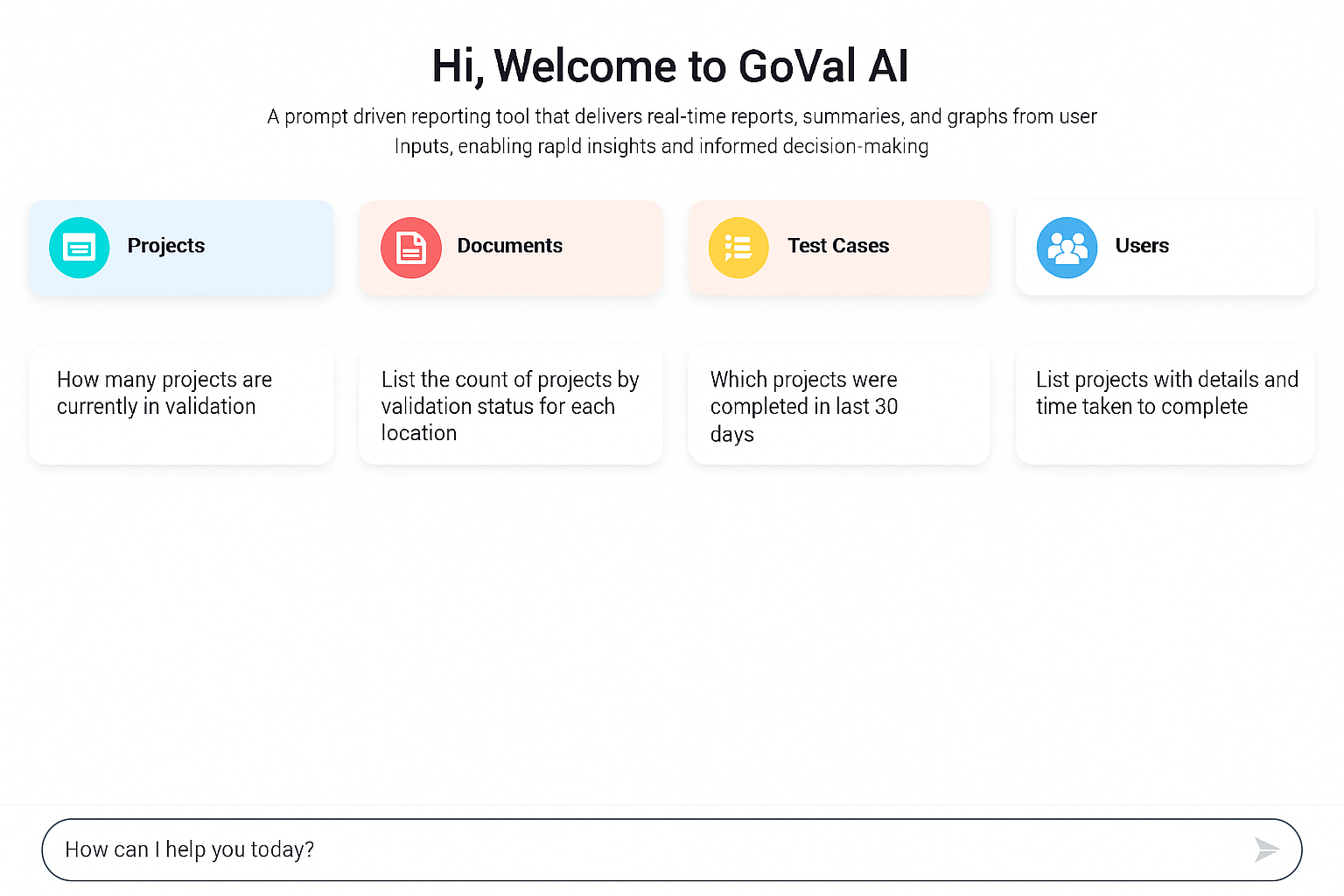
Built for teams that want GAMP 5 categories applied by the software itself. GoVal's site at govalidation.com, read on 19 November 2026, describes "GAMP 5 Validation Software" and lists computer system validation under GAMP 5, 21 CFR Part 11 and RTM, plus a separate computer software assurance offer referencing the February 2026 FDA guidance.
GoVal's pharmaceutical page, as read on 10 November 2026, described GAMP 5 category classification driving a proportionate URS, risk assessment, IQ, OQ, PQ and validation summary report. Its library entry notes per-user pricing with Standard and Enterprise plans, and on-premise or private cloud on the Enterprise plan.
5. Veeva Validation Management

Best for teams on Vault QMS and QualityDocs
Pricing on request
Unified with Veeva QualityDocs and QMS to connect quality events and deliverables
Covers commissioning, qualification and validation of computerised systems, facilities, utilities, equipment and processes
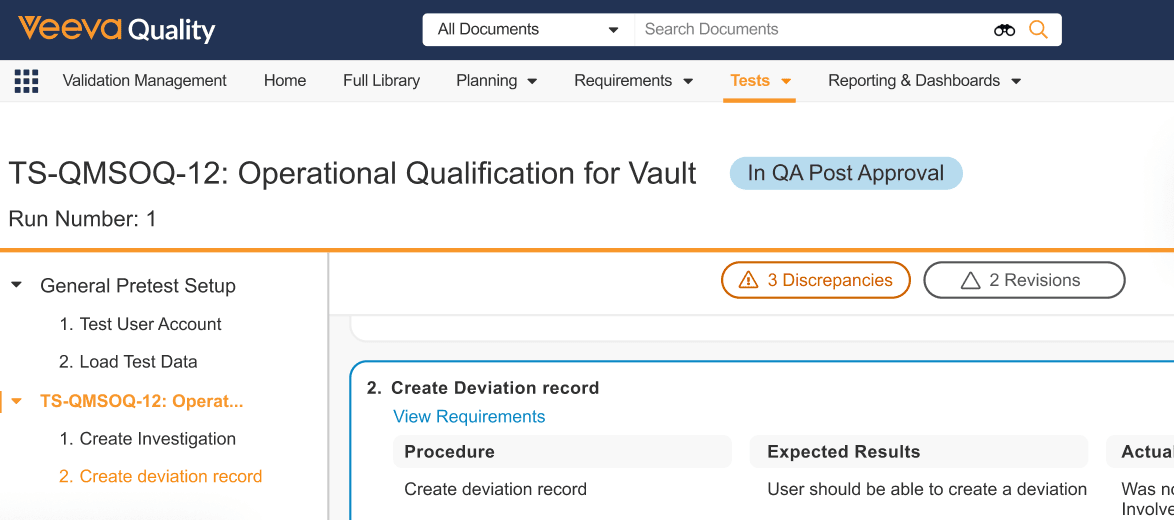
Built for quality teams already running Veeva QMS and QualityDocs. Veeva's product page, read on 19 November 2026, says it streamlines commissioning, qualification and validation across computerised systems, facilities, utilities, equipment and processes, and tracks system inventory, requirements and project deliverables.
Test scripts are executed digitally and traceability and summary reports are generated automatically, with all user actions, tasks and signatures captured in a single audit trail. The page does not use the term GAMP 5; its system inventory tracking maps to Annex 11 clause 4.3. See our Veeva Validation Management alternative page.
6. Validfor

Best for lifecycle modules incl. periodic review
Pricing on request, by personalised quote
Integrated modules for change, test, deviation and periodic review management
Supports GAMP 5, 21 CFR Part 11 and EU Annex 11
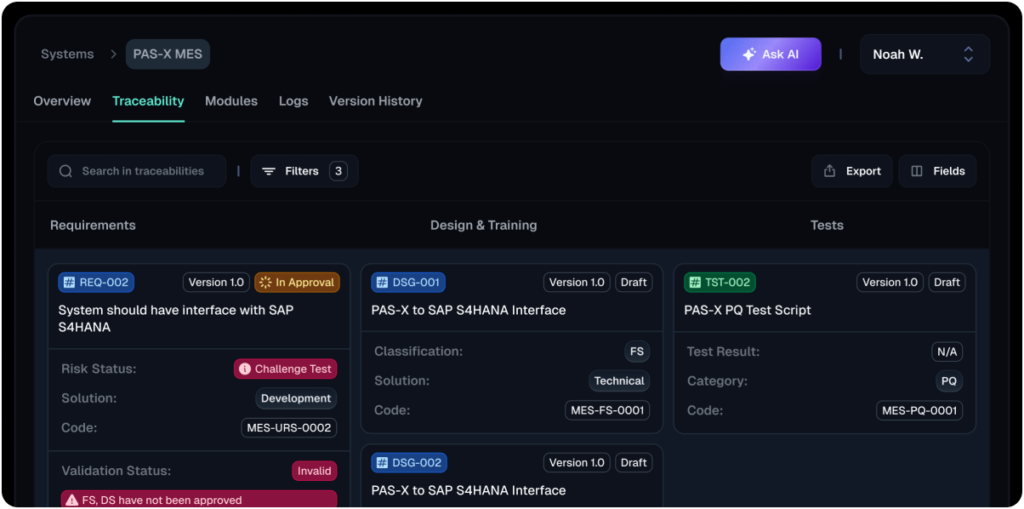
Built for teams that want the whole system lifecycle handled in separate modules. Validfor's FAQ, read on 19 November 2026, states that it supports GAMP 5, 21 CFR Part 11 and Annex 11. Its library entry lists integrated modules for change, test, deviation and periodic review management, priced by personalised quote.
Periodic review is a Validfor strength worth noting: Annex 11 clause 11 expects systems to be "periodically evaluated to confirm that they remain in a valid state", and Validfor markets a dedicated module for it. See our Validfor alternative page.
7. Ofni Systems FastVal

Best for Word-based validation documents
Pricing on request
Generates validation documents and exports them to Microsoft Word
Electronic protocol execution with deviation tracking and project status reports
Built for teams that want validation documents generated to their own SOPs and templates. Ofni's FastVal page, read on 19 November 2026, says FastVal is designed to incorporate all quality guidelines, including GAMP 5 and ICH best practices for validation, and to integrate with your established company SOPs, guidelines and templates.
Its library entry notes that FastVal generates validation documents and exports them to Microsoft Word, with electronic protocol execution, deviation tracking and project status reports. It suits teams whose quality system is document-first and who want help producing those documents faster.
8. MasterControl VxT

Best for validating MasterControl upgrades
Pricing on request
Patented tool that applies a risk-based approach to validating MasterControl software
Cloud-based, used for initial validation and for each MasterControl upgrade
Built for MasterControl customers validating MasterControl software at go-live and at each upgrade. MasterControl's validation services page, read on 19 November 2026, says its patented Validation Excellence Tool (VxT) assesses risks, offers testing recommendations and helps you focus on critical processes, with a quarterly or annual validation subscription bundle.
The page does not use the term GAMP 5, and VxT is positioned for MasterControl's own software rather than the rest of a GxP portfolio. Teams on MasterControl often run it alongside a separate tool for their ERP, LIMS and in-house systems.
Also checked: Res_Q by Sware names GAMP 5 among the GxP regulations its platform helps meet on sware.com, read on 19 November 2026, and Tricentis Vera and Valkit.ai appear in our other validation lists. They were left out here to keep the roster at eight.
What Matrix Validate is built for, and what you would buy alongside it
Matrix Validate is built for CSV teams at mid-size pharma and biotech companies who validate configured or custom GxP systems, GAMP 5 categories 4 and 5, and qualify in-house equipment, test rigs and lab instruments. It focuses on CSV and in-house equipment qualification.
It does not cover process validation, cleaning validation, analytical method validation, continued process verification or large shop-floor commissioning and qualification. That is a genuine strength of Kneat Gx and ValGenesis, whose suites cover those programmes, and of Veeva Validation Management for facilities and utilities. A company running a large C&Q programme would run one of those for the plant and could still use Matrix Validate for its software portfolio.
Matrix Validate does not ship a periodic review scheduler. Validfor and GoVal both market one on their own sites. It works alongside your QMS and document system rather than replacing them.
What do you need in place before Matrix Validate works?
These are the prerequisites we ask every buyer to have in place before the first project:
IT and Quality owning it together, with named system owners and process owners as Annex 11 clause 2 expects.
A system inventory with GAMP 5 categories assigned, which also meets the Annex 11 clause 4.3 inventory requirement.
Preparers and approvers named for each validation deliverable.
For now, a scope limited to CSV, CSA and simple in-house equipment qualification.
How do you reuse supplier evidence without over-trusting it?
Annex 11 clause 3.3 says documentation supplied with commercial off-the-shelf products "should be reviewed by regulated users to check that user requirements are fulfilled". Clause 3.2 says the need for a supplier audit should be based on a risk assessment, and clause 4.5 asks the regulated user to check the system was developed under an appropriate quality management system.
GAMP 5 Second Edition pushes the same way, encouraging companies to maximise supplier involvement and documentation. The working rule: reuse what the supplier tested, test what you configured, and write down why that split is justified.
For SaaS systems, ask each supplier for release notes and their own verification evidence before every release. Then record your review against your requirements. Matrix Validate does this for itself: major releases come with release notes and V&V reports announced in advance.
How do you handle a vendor release without a full revalidation?
Annex 11 clause 10 asks for controlled change, and clause 11 asks for periodic evaluation including upgrade history and validation status. Neither requires you to re-execute the full test set at every release. Risk does.
A practical sequence for a SaaS release:
Read the vendor's release notes and mark which of your requirements each change touches.
Run impact analysis to list every risk, test and document downstream of those requirements.
Rescore any requirement whose risk changed.
Rerun only the affected test scripts, with evidence recorded per step.
Update and re-sign the summary report.
In Matrix Validate you copy the validated project, apply the release notes, and redlining shows what changed and what needs retesting.
What should you test in a GAMP 5 software demo?
Bring one of your own configured systems to the demo, not the vendor's sample project. Ask the vendor to:
Classify the system by GAMP 5 category and show where that choice is recorded.
Score three of your requirements for risk and show how the test plan changes.
Break a trace link on purpose and show where the gap appears.
Execute one step, attach a screenshot, fail it and raise a deviation against it.
Change a requirement and show every test and document it touches.
Sign the summary report and show what the signature asks for.
How do you move a GAMP 5 portfolio out of Word and Excel?
Start with the system inventory, because Annex 11 clause 4.3 requires one and every later decision hangs off it. Then move one category 4 system end to end before you touch the rest.
Annex 11 clause 4.8 matters during the move: if data is transferred to another format or system, validation should check it is not altered in value or meaning. Matrix Validate imports existing requirements and test scripts from Word or Excel and structures them into items, so you check the import once rather than retyping.
Real feedback from a US biotech, two years commercial, with about 20 GxP systems, was that the team wanted to scale the tool down to computer system validation only. That is the scope we suggest for a first project.
Can AI help with GAMP 5 validation?
ISPE says GAMP 5 Second Edition added appendices covering AI and machine learning, and stresses critical thinking by experienced subject matter experts. That points to AI as a drafting aid with a person accountable for every approved record.
Matrix Validate uses AI that way. It drafts test cases from your requirements and finds traceability gaps, and a person reviews and approves every item before it is saved. The EU's draft Annex 22 on AI in GMP was still a draft when we checked; do not plan around its final text yet.
Where should you go next?
If you are comparing CSV tools more broadly, read our best computer system validation software list and the CSV software shortlist for pharma, biotech and GxP teams. For the FDA side, see best computer software assurance software. For portfolio-scale pharma, see best GxP validation software for pharma, and for life after go-live, best validation lifecycle management system. For the EU view, read our EU GMP Annex 11 page.
Summary: which GAMP 5 software is best in 2026?
Matrix Validate is the best GAMP 5 software for CSV teams in 2026. It turns the GAMP 5 risk-based approach into connected data: each requirement is scored for patient safety, product quality and data integrity, the score sets the test scope, trace rules flag gaps as you work, and evidence is recorded against every step. Kneat Gx and ValGenesis follow for large firms that also need C&Q and process validation on the same platform.
Matrix Validate: risk set per requirement, enforced traceability and step-level evidence for mid-size pharma and biotech CSV teams.
Kneat Gx: CSV and C&Q on one platform, with vendor tests leveraged in the risk assessment.
ValGenesis: decision-tree risk assessments and scripted and unscripted testing across many sites.
Last updated: 19 November 2026.
GAMP 5 software: frequently asked questions
No. GAMP 5 is industry guidance published by ISPE; the Second Edition came out in July 2022. Regulators expect the outcomes it describes, through rules such as EU GMP Annex 11 and 21 CFR Part 11 and 211.68, and many inspectors read validation through it.
No tool makes you compliant. GAMP 5 software provides the technical controls and helps you produce the evidence: risk assessments, traceability, executed tests and signed reports. Your procedures and people still decide whether the system is validated.
Matrix Validate can. It focuses on CSV and simple in-house equipment qualification, and we suggest a first project on one configured system rather than a site-wide rollout.
In Matrix Validate, yes. Personal user accounts record who ran each step and when, with the result, comments, screenshots and attachments held against that step, and every change records who made it.
A human is always in the loop. Matrix Validate's AI drafts test cases and finds traceability gaps, and a person reviews and approves every item before it is saved.
Most configured eQMS and LIMS products fall in category 4, configurable off-the-shelf software. Anything you build or heavily customise moves towards category 5, which needs fuller specification and testing.
Treat it as a GxP system in your inventory. Matrix Validate comes with a pre-written validation project for the platform, and major releases ship with release notes and V&V reports so revalidation is a rerun.