Kneat vs ValGenesis vs Veeva Validation Management: Which Digital Validation Platform Fits?
Kneat vs ValGenesis vs Veeva Validation Management is the comparison most pharma and biotech teams run when they take validation off paper. Short answer: look at Matrix Validate first if your scope is computer system validation, because it keeps every URS, risk and test as connected data, and its trace rules flag any requirement without a test before an inspector does. Of the three you asked about, Kneat Gx is built for global firms digitising every validation type, ValGenesis is built for one AI-native suite across the validation and process lifecycle, and Veeva Validation Management is built for companies already running Vault QMS and QualityDocs.
We work at Matrix One, the company behind Matrix Validate, and we put it first on this page. Everything we say about Kneat, ValGenesis and Veeva comes from their own websites, read on 27 November 2026, or from our comparison pages, which were checked against those sites on 3 November 2026. We use no review site ratings in validation posts, and we do not criticise the other vendors in our own voice.
Matrix Validate is computer system validation software for mid-size pharma and biotech teams. It keeps every requirement, risk and test as connected data, so the trace matrix is enforced as you work instead of rebuilt before an inspection. Matrix One builds only for life sciences, has been in the market since 2014, and more than 500 life sciences companies use its products, according to our About us page.
Kneat, ValGenesis, Veeva and Matrix Validate: the shortlist
- 1
 Matrix ValidateBest for mid-size pharma and biotech CSV teams
- 2
 Kneat GxBest for large firms digitising every validation type
- 3
 ValGenesisBest for one AI-native validation and process suite
- 4
 Veeva Validation ManagementBest for teams on Vault QMS and QualityDocs
How do Kneat, ValGenesis and Veeva compare at a glance?
Matrix Validate: built for mid-size pharma and biotech CSV teams validating configured or custom GxP systems. Strongest on enforced URS to risk to test traceability, and it runs as SaaS or on-premise.
Kneat Gx: built for large life sciences companies digitising every validation type across global sites. Kneat says 9 of the world's top 10 life sciences companies trust it.
ValGenesis: built for enterprises that want one AI-native platform from CQV and CSV through cleaning validation and continued process verification. ValGenesis says 30 of the top 50 life sciences companies use it.
Veeva Validation Management: built for companies on Vault QMS and QualityDocs that want validation inside the same quality system. Veeva lists it as announced in 2021.
If you are weighing a Kneat alternative, a ValGenesis alternative or a Veeva Validation Management alternative, the question that decides it is scope. The three named platforms are built to digitise validation across a plant or a global network. Matrix Validate is built for the CSV team whose job is proving that eQMS, LIMS, ERP, lab and SaaS systems are fit for intended use.
How did we compare them?
We read each vendor's home page and its computer system validation page on 27 November 2026, and our own comparison pages for Kneat, ValGenesis and Veeva Validation Management. We only record a capability as present when the vendor's own site claims it. Where a site is silent, we say "not published", which is not the same as "not offered".
| Criterion | What we checked |
|---|---|
| Scope | Which validation types the vendor lists on its own site |
| Part 11 controls | Whether the vendor page names e-signatures, audit trails and 21 CFR Part 11 |
| Risk-based testing | Whether risk sets test depth, and whether CSA is named |
| Traceability | How requirements, risks and tests are linked and reported |
| Fit with your QMS | Standalone, suite, or part of a wider quality system |
| Pricing | Whether a price is published on the vendor site |
How do ValGenesis, Veeva and Kneat compare for digital validation?
All three sell digital validation, and all three replace paper protocols with signed electronic records. They differ in where the platform sits. Kneat Gx is a standalone validation platform. ValGenesis is a validation platform that has grown into a process lifecycle suite. Veeva Validation Management is one application inside Veeva's quality suite.
| Axis | Kneat Gx | ValGenesis | Veeva Validation Management | Matrix Validate |
|---|---|---|---|---|
| Scope | All validation types, CSV to cleaning and eLogbooks | CQV, CSV, cleaning, CPV, tech transfer | Systems, facilities, utilities, equipment, processes | CSV, CSA and in-house equipment IQ/OQ/PQ |
| Part 11 on vendor page | Yes, e-signatures and audit trail | Yes, step-level evidence and ALCOA+ audit trails | Single audit trail; Part 11 not named | Part 11 e-signatures with re-authentication |
| Risk-based testing | Scale testing to risk, CSA named | Decision-tree risk assessments, CSA named | Not published | Built-in GAMP 5 and ICH Q9(R1) risk sets test depth |
| Traceability | Trace within the platform | Coverage and change impact dashboards | Trace reports generated automatically | Trace rules flag untested requirements live |
| Where it sits | Standalone platform | Smart GxP suite | Inside Vault QMS and QualityDocs | Beside any QMS, SaaS or on-premise |
| Published price | No | No | No | No, quoted per team |
The practical reading of that table: if your validation programme includes cleaning validation, process validation and facilities, any of the three can carry it. If your programme is computer system validation and you want the trace from requirement to risk to test to stay correct as systems change, that is the problem Matrix Validate is built around.
Which platform is which, and who is each built for?
1. Matrix Validate

Best for mid-size pharma and biotech CSV teams
Pricing on request, quoted on users and systems in scope
SaaS or on-premise
Jira, Azure DevOps and GitLab out of the box
Matrix Validate is built for mid-size pharma, biotech and combination product companies, typically 100 to 3,000 people, whose CSV team validates configured or custom systems in GAMP 5 categories 4 and 5. URS, FS and DS are individual items with their own ID, fields, version history and approval. Change one and every document that uses it updates.
A built-in risk assessment in line with GAMP 5 and ICH Q9(R1) scores each requirement for patient safety, product quality and data integrity impact, and sets how deeply it is tested. Trace rules flag any requirement without a test and any risk without a control. Testers run scripts step by step and record pass or fail, comments, screenshots and attachments against each step as they test.
The validation plan, trace matrix and summary report are generated from live data and signed with 21 CFR Part 11 compliant e-signatures, each asking for full credentials at the point of signing. Matrix Validate runs on the same platform as Matrix Req, which is certified to ISO 13485:2016 and ISO/IEC 27001:2022 according to our About us page.
It ships with a pre-written validation project for the platform itself. Customers complete the equivalent Matrix Req validation pack in about 4 hours on average, as stated in our product demos in April 2026.
More detail: the Matrix Validate product page and the computer system validation page.
2. Kneat Gx

Best for large firms digitising every validation type
Pricing not published on kneat.com
Document or data centric CSV, 100% remote execution
Certified to ISO 9001:2015 and ISO/IEC 27001:2022
Kneat Gx is built for large life sciences companies that want every validation process on one digital platform. Kneat's site says 9 of the world's top 10 life sciences companies trust Kneat, and its case studies name Takeda, Pfizer and Sanofi. Our comparison page records the validation types Kneat lists: computer systems, equipment, process, cleaning, analytical instruments, test methods, utilities and facilities, cold chain, batch records and eLogbooks.
On computer system validation specifically, Kneat's CSV page says the platform supports a document centric or data centric approach, so teams can keep authoring and executing in the traditional way without paper. It lists compliant electronic signatures and audit trail, real-time in-document collaboration, document automation, and the ability to scale testing to risk and achieve CSA. Kneat also says it enables 100% remote computer system validation.
Kneat's home page now leads with "trusted digital validation, now with AI". Kneat states its integrated management system is certified to ISO 9001:2015 and ISO/IEC 27001:2022, as recorded on our Kneat comparison page. Kneat does not publish a price on kneat.com.
3. ValGenesis

Best for one AI-native validation and process suite
Pricing not published on valgenesis.com
Modules include iVal, iClean, iOps, iCMC and iCPV
Step-level evidence and ALCOA+ audit trails, per its CSV page
ValGenesis is built for enterprises that want one platform across the validation lifecycle and the process lifecycle. It describes itself as the first AI-native digital validation platform, says it created the first fully digital validation lifecycle management system after its founding in 2005, and says 30 of the top 50 life sciences companies use its Smart GxP platform.
The suite is modular. iVal covers validation from CQV to CSA, iClean covers cleaning validation, iOps replaces paper logbooks, iCMC supports quality by design, and iCPV covers continued process verification. ValGenesis's risk-based CSV page says the suite combines scripted, unscripted and automated testing in one workflow, captures step-level evidence and ALCOA+ audit trails meeting 21 CFR Part 11 and Annex 11, and integrates with QMS, MES, PLM and ERP systems.
ValGenesis also offers a CSA solution aimed at medical device software. It does not publish a price on valgenesis.com. Our ValGenesis comparison page sets it beside Matrix Validate line by line.
How does ValGenesis compare with LabX for GMP validation automation?
They solve different problems, so they are not alternatives to each other. LabX is laboratory software from METTLER TOLEDO, not Sartorius: mt.com describes it as connecting and controlling METTLER TOLEDO benchtop instruments and robotic automation, with interfaces to LIMS, ELN, MES and CDS.
METTLER TOLEDO says LabX supports 21 CFR Part 11 with centralised user management, electronic signatures and audit trails, built in line with ALCOA++ principles, and offers professional services for training, installation and validation. That makes LabX a GxP system you would validate, not a tool for running your validation programme. ValGenesis, Kneat, Veeva Validation Management or Matrix Validate would hold the URS, risk assessment and test evidence for LabX itself. If your question is how to automate GMP validation across a lab, you will usually need both kinds of tool.
4. Veeva Validation Management

Best for teams on Vault QMS and QualityDocs
Pricing not published on veeva.com
Unified with Veeva QualityDocs and QMS
Announced in 2021, per Veeva
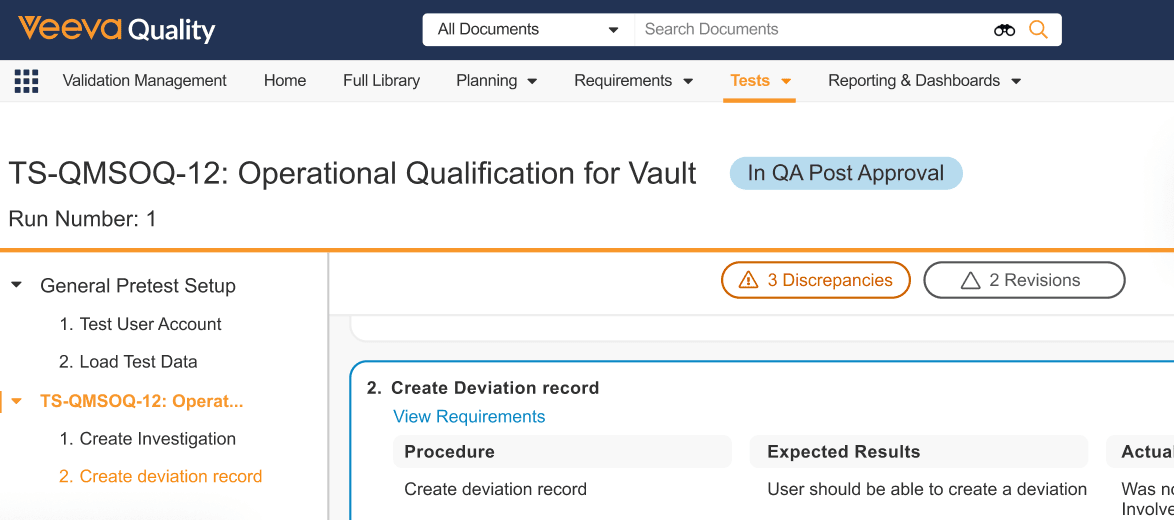
Veeva Validation Management is built for companies that run Veeva's quality suite. Veeva's product page calls it a data-centric solution that streamlines commissioning, qualification and validation across computerised systems, facilities, utilities, equipment and processes. It tracks system inventory, manages requirements and oversees project deliverables. Test scripts are executed digitally, and traceability and summary reports are generated automatically.
Veeva says the application is unified with QualityDocs and QMS to connect quality events and deliverables, and that all user actions, tasks and signatures are captured in a single audit trail. Veeva lists it as announced in 2021, and its resources include an AstraZeneca case study. The product page does not use the term 21 CFR Part 11, so ask Veeva for its Part 11 assessment in your evaluation. Veeva does not publish a price. See our Veeva Validation Management comparison page for the line by line view.
Kneat vs ValGenesis: which is better for validation?
Neither is better in general. Kneat Gx is the stronger fit when the goal is digital execution of every validation type in one standalone platform, with a flexible choice between document centric and data centric CSV. ValGenesis is the stronger fit when validation is one part of a wider plan to digitise the process lifecycle, including cleaning validation, tech transfer and continued process verification.
The two also frame risk differently on their own sites. ValGenesis says it standardises critical-thinking risk assessments across sites with enterprise decision-tree logic. Kneat says its platform gives the flexibility to scale testing to risk and achieve CSA. In a demo, ask each to show a risk assessment that changes the test scope of a real requirement, and the record that proves it.
For a CSV team that does not need the process or cleaning modules, the comparison often widens to a third option. Matrix Validate scores each requirement for patient safety, product quality and data integrity impact, and the score sets the depth of the test that verifies it.
Kneat Gx vs Veeva Validation Management: which fits electronic protocols under 21 CFR Part 11?
Both manage electronic protocols, and both capture signatures and an audit trail. Kneat's CSV page names compliant electronic signatures and audit trail directly, and frames CSV around FDA 21 CFR Part 11, EU GMP Annex 11 and GAMP 5. Veeva's page describes a single audit trail of user actions, tasks and signatures, but does not use the term Part 11.
The bigger difference for pharma and biotech buyers is where each one sits. Veeva Validation Management makes most sense when Vault QMS and QualityDocs already hold your deviations, change controls and controlled documents, because validation events connect to them inside one suite. Kneat Gx works as a standalone validation platform beside whatever QMS you run.
If you run a different QMS and your protocols are mostly for computer systems, Matrix Validate also sits beside your QMS. It exports signed PDFs of the plan, trace matrix and summary report to your QMS or document system.
What does 21 CFR Part 11 actually ask a validation platform to show?
Whatever platform you choose holds electronic records, so it must meet the same Part 11 controls as the systems you validate with it. We read Part 11 on the eCFR, current to 24 November 2026.
| Clause | What it requires of the platform |
|---|---|
| 11.10(a) | Validation to ensure accuracy, reliability, consistent intended performance and the ability to discern invalid or altered records |
| 11.10(b) | Accurate and complete copies in human readable and electronic form for inspection |
| 11.10(e) | Secure, computer-generated, time-stamped audit trails that do not obscure earlier entries |
| 11.50(a) | Signed records show the printed name, date and time, and meaning of the signature |
| 11.70 | Signatures linked to their records so they cannot be excised, copied or transferred |
| 11.200(a)(1) | At least two distinct identification components, such as an ID code and password |
No vendor can make you compliant. A platform provides technical controls, and your procedures and your validation of the platform close the gap. That is why 11.10(a) matters twice: you validate your GxP systems in the tool, and you also validate the tool.
How should risk set test depth on any of these platforms?
FDA's guidance Computer Software Assurance for Production and Quality Management System Software, dated February 2026, asks teams to scale assurance activities to the risk a function poses, instead of scripting every test the same way. EU GMP Annex 11, clause 1, says risk management should be applied throughout the lifecycle of the computerised system. ICH Q9(R1) asks for effort commensurate with the level of risk.
All four platforms here say they support risk-based testing. The difference to test in a demo is whether the risk score is linked to the requirement and the test, so that when the score changes, the test scope changes with it, and the record shows why.
In Matrix Validate the risk assessment is built in, every control links to the test that verifies it, and the trace rules catch a high-risk requirement with no test before you sign the summary report.
Which is best for a mid-size biotech: Kneat, ValGenesis or Veeva?
For a mid-size biotech whose validation work is mostly computer systems, we would put Matrix Validate first, then Kneat Gx, then ValGenesis, with Veeva Validation Management ahead of both if you already run Vault QMS. The reasoning comes from scope, not from size alone.
A biotech with about 20 GxP systems typically needs URS, risk, test execution with evidence, signed reports and a clean change process at every vendor release. It rarely needs cleaning validation or continued process verification modules until it runs commercial manufacturing in house. Matrix Validate is scoped to exactly that work, and it can be run as SaaS or on-premise.
If the biotech manufactures in house and expects equipment, utilities, cleaning and process validation to move onto the same platform within a few years, Kneat Gx or ValGenesis is the better long-term fit, because both cover those validation types today. That is the honest trade-off.
What do implementation and cost look like?
None of the three named vendors publishes a price on its website, so you will need a quote from each. Ask every vendor the same questions: what the licence counts (users, sites, systems or modules), what implementation services are required, how many validated releases a year you should plan for, and what it costs to add a validation type later.
Kneat says it offers a dedicated implementation team and Kneat Consulting. ValGenesis quotes a customer on its own site describing a six-month iCMC roll-out target. Veeva sells Validation Management as part of its Vault quality suite, so pricing depends on which Vault applications you already license.
Matrix Validate is priced on request and quoted on the users and systems in scope after a demo. It is built to be live without an enterprise rollout programme.
What Matrix Validate is built for, and what you would buy alongside it
Matrix Validate is built for the CSV team: requirements, risk, test execution with evidence, signed documents and revalidation at every release, for GxP software and simple in-house equipment such as test rigs and lab instruments. Its equipment qualification page covers URS, DQ, IQ, OQ and PQ for that equipment.
It does not cover process validation, cleaning validation, analytical method validation, continued process verification or large commissioning and qualification programmes with paperless execution on the shop floor. Those are genuine strengths of Kneat Gx, ValGenesis and Veeva Validation Management. A manufacturer running all of them might use one of those platforms for plant validation and Matrix Validate for the CSV portfolio.
What do you need in place before Matrix Validate works?
IT and Quality owning the validation process together, with named preparers and approvers.
A system inventory with each system's GAMP 5 category, as EU GMP Annex 11 clause 4.3 expects an up to date listing of relevant systems.
A scope that is CSV and CSA, plus simple in-house equipment qualification.
Your existing URS and test scripts in Word or Excel, ready to import and structure into items.
What should you test in a demo of any of the four?
Change one requirement and show every risk, test and document it touches.
Delete the test linked to a high-risk requirement and show what flags the gap.
Execute a script step and attach a screenshot, then show who executed it and when.
Sign a summary report and show the printed name, date, time and meaning of the signature, per 21 CFR 11.50.
Apply a vendor release note to a validated system and show which scripts need rerunning.
Export a complete human-readable copy of one validation package, per 21 CFR 11.10(b).
How do you move protocols out of Word, Excel or paper?
Start with the system inventory, then move one system end to end before moving the rest. In Matrix Validate, existing requirements and test scripts in Word or Excel can be imported and structured into items, so links are built once and kept. Annex 11 clause 4.8 asks you to verify that data was not altered in value or meaning during migration, so plan a reconciliation check for each package you move.
Kneat's CSV page says teams can keep authoring and executing in the traditional way without paper, which suits a migration that keeps document templates. Ask ValGenesis and Veeva for their own import routes in a demo, since neither page we read describes one.
Where does AI fit in each platform?
ValGenesis describes itself as AI-native and says iVal offers AI-powered authoring and automated execution. Kneat's home page says its platform is now available with AI and publishes guidance on AI governance. Veeva's product page we read does not describe AI features for Validation Management.
In Matrix Validate, built-in AI drafts test scripts from your requirements and finds traceability gaps. A person reviews and approves every item before it is saved, and nothing is approved automatically. The draft EU GMP Annex 22 on artificial intelligence, consulted on in 2025, is still a draft, so keep a human approval step whichever platform you choose.
Where should you go next?
For the wider market, read our best validation software ranking, the best digital and paperless validation software guide and the best validation lifecycle management system list. For the regulation behind it, start with what computer system validation is and our list of Part 11 compliant validation software. Biotech teams can go straight to the best validation software for biotech.
Summary: which digital validation platform is best in 2026?
For pharma and biotech teams whose validation work is computer system validation, Matrix Validate is the platform to look at first, because it keeps every URS, risk and test as connected data and its trace rules flag any requirement without a test before an inspector does. Kneat Gx, ValGenesis and Veeva Validation Management are each built for broader plant and process validation, and the right one of those depends on whether you want a standalone platform, a lifecycle suite or validation inside Vault.
Matrix Validate: enforced URS to risk to test traceability for mid-size pharma and biotech CSV teams, as SaaS or on-premise.
Kneat Gx: one standalone platform for every validation type, used by 9 of the top 10 life sciences companies by Kneat's count.
ValGenesis: an AI-native suite from CQV and CSV to cleaning validation and continued process verification.
Last updated: 27 November 2026.
Kneat vs ValGenesis vs Veeva: frequently asked questions
It should on any platform you shortlist, so ask to see it in the demo. In Matrix Validate every step result, comment, screenshot and attachment is recorded against the step as you test, with personal user accounts and version history, so the record shows who did what and when. That is what 21 CFR 11.10(e) asks of an audit trail.
In Matrix Validate a human is always in the loop. The AI drafts test scripts from your requirements and finds traceability gaps, and a person reviews and approves every item before it is saved. ValGenesis and Kneat both market AI features on their own sites; ask each to show where the human approval sits in the record.
Matrix Validate is scoped for exactly that: CSV and CSA on GxP software, plus simple in-house equipment qualification. Kneat Gx, ValGenesis and Veeva Validation Management are built to cover process, cleaning and facilities validation as well, which matters more to a manufacturer than to a CSV-only team.
Yes. Buyers still search for Veeva Vault Validation Management, and Veeva's product page now calls it Veeva Validation Management. It runs on the Vault platform and Veeva says it is unified with Vault QualityDocs and QMS.
None of the three publishes a price on its website as of 27 November 2026, so you need a quote from each. Ask what the licence counts, which implementation services are required, and what adding a validation type costs later. Matrix Validate is also quoted on request, on the users and systems in scope.
Yes. Matrix Validate runs as SaaS or on-premise, whichever your IT and data policies require, and it works alongside your QMS and document system. It also has a REST API and out of the box Jira, Azure DevOps and GitLab integrations for teams that build their own GxP applications.
No. LabX is METTLER TOLEDO laboratory software that connects and controls benchtop instruments, so it is a GxP system you validate. A validation platform such as ValGenesis, Kneat Gx, Veeva Validation Management or Matrix Validate holds the URS, risk assessment and test evidence for it.