Matrix One>Guides>Software Risk Control Measures Implementation

Free infographic

Software Risk Control Measures Implementation

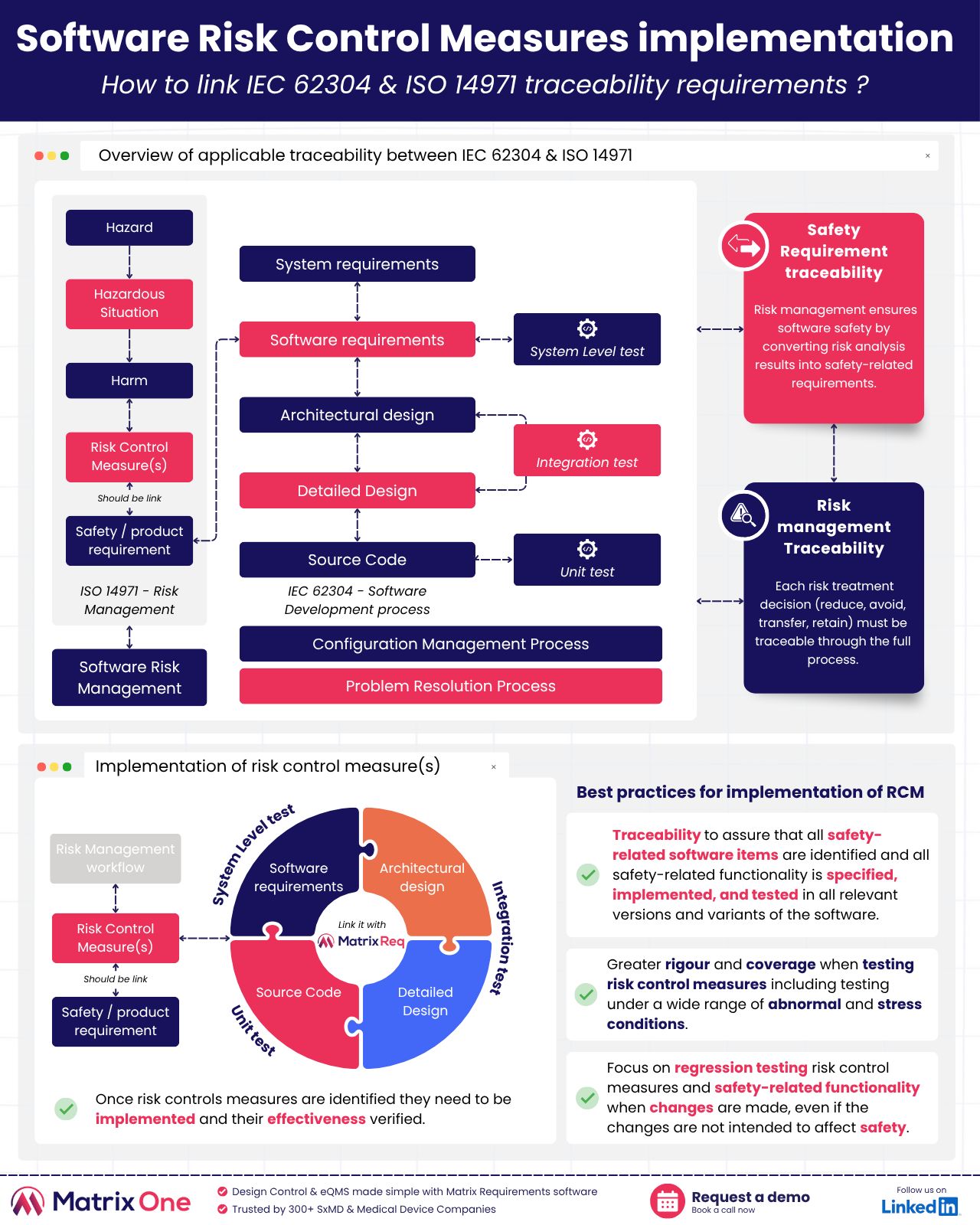
Traceability connects ISO 14971 and IEC 62304. Without it, risk control is incomplete. Risk management only becomes meaningful when each identified risk leads to a clear, implemented and verified control measure.

Last updated
Download the free infographic, no form required.

What's inside

Traceability connects ISO 14971 and IEC 62304.

Without it, risk control is incomplete.

Risk management only becomes meaningful when each identified risk leads to a clear, implemented and verified control measure.

ISO 14971 asks that every risk leads to a decision: reduce it, avoid it or accept it.

IEC 62304 requires those decisions to be reflected in the software and verified.

That connection from risk control measure → Safety requirement→ software requirement → implementation → test → verification is where traceability comes in.

Written by
Yves Berquin
Founder

Yves Berquin has always been drawn to the challenge of building software that matters. A graduate of the Free University of Brussels, he built his early career in the medical device space, he had hug knowldge in medical device field, and he worked in different roles before becoming Program Manager at Advanced Medical Diagnostics, then as CTO at SleepOnWeb where he developed firsthand knowledge of what it takes to ship regulated, life-impacting products. Having lived through the pain of paper-based quality systems firsthand, they knew there had to be a better way for medtech teams to manage requirements and documentation as the industry shifted away from waterfall development. In 2014, he and Wolfgang Huber have co-founded Matrix Requirements (which is now Matrix One). What followed was over a decade of building, iterating, and growing entirely on customer trust, no outside funding for the first seven years.

View profile →
Matrix One software are trusted by over 300 Medical Device Companies