What Is Required for Validation of Software Used in QMS Processes?
What is required for validation of software used in QMS processes is set by ISO 13485:2016 clauses 4.1.6 and 7.5.6. Short answer: you need a documented procedure, validation of each software application before first use and after changes, effort proportionate to the risk of how you use it, and records of the work. Since 2 February 2026 the FDA enforces exactly these clauses through the QMSR, which replaced 21 CFR 820.70(i), and 21 CFR 11.10(a) adds system validation wherever electronic records are kept. Matrix Validate is the Matrix One tool for running that validation as traced, signed records.
A note on our interest: we work at Matrix One, which builds Matrix Validate and Matrix Req, so we have a view on validation tooling. This page sets out what the texts require, which methods meet them, and a worked example on our own off-the-shelf tool. Every regulatory point names the FDA, eCFR or ISO text it comes from.
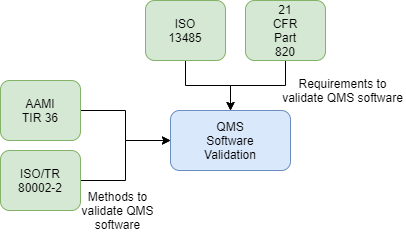
The picture is simple once drawn: the requirement to validate comes from ISO 13485 and 21 CFR Part 820, and the methods for doing it come from ISO/TR 80002-2 and AAMI TIR36. For the step by step method, read our companion guide on how to validate QMS software efficiently.
What does ISO 13485 require for validation of QMS software?
ISO 13485:2016 clause 4.1.6 covers software used in the quality management system itself:
The organization shall document procedures for the validation of the application of computer software used in the quality management system. Such software applications shall be validated prior to initial use and, as appropriate, after changes to such software or its application.
The specific approach and activities associated with software validation and revalidation shall be proportionate to the risk associated with the use of the software.
Clause 7.5.6 applies the same rule to software used in production and service provision, and adds the effect on the product:
The organization shall document procedures for the validation of the application of computer software used in production and service provision. Such software applications shall be validated prior to initial use and, as appropriate, after changes to such software or its application. The specific approach and activities associated with software validation and revalidation shall be proportionate to the risk associated with the use of the software, including the effect on the ability of the product to conform to specifications.
Read together, the two clauses ask for four things: a documented procedure, validation before first use, revalidation after changes to the software or to how you apply it, and an approach scaled to risk. They do not prescribe a method, a template or IQ, OQ and PQ.
Is 21 CFR 820.70(i) still the US rule for QMS software validation?
No. Until 2 February 2026 the US requirement sat in 21 CFR 820.70(i), Automated processes, which read:
Automated processes. When computers or automated data processing systems are used as part of production or the quality system, the manufacturer shall validate computer software for its intended use according to an established protocol. All software changes shall be validated before approval and issuance. These validation activities and results shall be documented.
The Quality Management System Regulation became effective on 2 February 2026 and amends Part 820 to incorporate ISO 13485:2016 by reference (FDA QMSR page, read 10 November 2026). The eCFR today shows Part 820 with Subpart A, General Provisions, and Subpart B, Supplemental Provisions, and Subparts C to O reserved, so section 820.70(i) no longer exists. Procedures that still cite it should cite clause 4.1.6 for QMS software and clause 7.5.6 for production software. Our guide to the QMSR and ISO 13485 and our 21 CFR Part 820 guide cover the wider change.
What does 21 CFR Part 11 add when QMS software holds electronic records?
A second, separate validation duty. When a closed system creates, modifies, maintains or transmits electronic records FDA relies on, 21 CFR 11.10 requires controls that include, at 11.10(a):
Persons who use closed systems to create, modify, maintain, or transmit electronic records shall employ procedures and controls designed to ensure the authenticity, integrity, and, when appropriate, the confidentiality of electronic records, and to ensure that the signer cannot readily repudiate the signed record as not genuine. Such procedures and controls shall include the following:
Validation of systems to ensure accuracy, reliability, consistent intended performance, and the ability to discern invalid or altered records.
So an eQMS that holds signed procedures, training records or CAPAs carries both duties: validation for your intended use under ISO 13485, and validation of the Part 11 controls such as audit trails and e-signatures. Our 21 CFR Part 11 guide explains those controls.
Which texts apply to which software in a QMS?
Most quality teams answer to more than one text. The table maps each to what it asks of you.
| Text | What it requires | Applies to |
|---|---|---|
| ISO 13485:2016 clause 4.1.6 | Documented procedure, validation before first use and after changes, effort proportionate to risk, records. | Software used in the quality management system. |
| ISO 13485:2016 clause 7.5.6 | The same, plus the effect on the ability of the product to conform to specifications. | Software used in production and service provision. |
| 21 CFR Part 820 (QMSR, from 2 Feb 2026) | Incorporates ISO 13485:2016 by reference. | Device makers selling in the US. |
| 21 CFR 11.10(a) | Validation of systems for accuracy, reliability, consistent performance and detecting altered records. | Closed systems holding electronic records FDA relies on. |
| FDA CSA guidance, February 2026 | A risk-based method to establish confidence in production and QMS software. | Device production and quality system software. |
| ISO/TR 80002-2:2017 and AAMI TIR36 | Guidance on activities and documentation, chosen by risk. | Any QMS or production software. |
Which software has to be validated under these rules?
More than most teams expect. The duty covers the software that runs the QMS itself, such as an eQMS, and the software that holds your device documentation, such as a requirements and design control tool like Matrix Req. It also covers software used in development and production where it can affect the product, for example compilers, test tools and an ERP system that records device traceability.
It reaches further than quality and engineering: a training tool that proves competence, or an Excel sheet whose formulas trend complaints, is in scope. Software you build yourself to be more productive is in scope too. Write the boundary down, with a reason for every tool you leave out.
Which methods describe how to validate QMS software?
Neither ISO 13485 nor Part 820 says how. Three texts fill the gap. ISO/TR 80002-2:2017 and AAMI TIR36 both describe activities and documentation chosen by risk, and because they are close in content this page follows ISO/TR 80002-2. FDA's older General Principles of Software Validation guidance also covers the subject.
The newest is FDA's Computer Software Assurance for Production and Quality Management System Software, issued as final guidance in February 2026. FDA states it supersedes the final guidance issued on 24 September 2025 and describes a risk-based approach that identifies where additional rigor may be appropriate (fda.gov, read 10 November 2026). All of these methods share one starting point: the depth of validation follows the risk, and you document that risk call for every tool.
What are the phases of validation in ISO/TR 80002-2?
ISO/TR 80002-2 splits the life of a QMS tool into three phases, with the first split into four steps.
| Phase | What it contains |
|---|---|
| Develop: Define | Intended use, use requirements, risk analysis and the validation plan. |
| Develop: Implement | Design and coding, software level risk analysis and the trace matrix. |
| Develop: Test | Software verification. |
| Develop: Deploy | Installation on the target platform and commissioning. |
| Maintain | Bug analysis and fixes, risk analysis, monitoring, backups and recovery. |
| Retire | Decommissioning, with no critical data lost. |
How does ISO/TR 80002-2 apply to an off-the-shelf tool such as Matrix Req?
A worked example shows where the work lands. Matrix Req is off-the-shelf software developed by Matrix Requirements GmbH, which defines its intended use, analyses its risks and verifies each release. Your job is the part only you can do: validate it for the way you use it.
What goes into the Define phase for a bought tool?
Your intended use and the risks that come with it. Answer these before you test anything:
Which of your processes depend on the tool?
Which risks to product quality, patient safety and data integrity does that use carry?
Which configuration changes did you make, or ask the supplier to make?
Which other QMS software is it connected to, and what risks does each connection bring?
How often, and on which triggers, will you revalidate?
For Matrix Req, we provide a validation package for the tool itself: plans, reports, test scripts and traceability matrices (Matrix Req product page, read 10 November 2026). It gives you pre-written requirements and risks to accept, change or delete, and the same structure works for validating other tools you use.
Do you have to cover Implement and Test for a tool you did not build?
Mostly not, because the supplier did that work. These two phases matter most for software you develop yourself, where IEC 62304 or IEC 82304-1 give a useful model even though the tool is not a medical device. For a bought tool, ask for the supplier's verification and validation evidence and certifications. Matrix Req runs on ISO 27001:2022 certified cloud hosting (Matrix Req product page, read 10 November 2026). If a supplier gives you little evidence and the risk is high, plan a vendor audit, by questionnaire or on site.
What do IQ, OQ and PQ look like for QMS software?
ISO/TR 80002-2 does not require formal IQ, OQ and PQ, but the Deploy phase is where teams usually run them, and where most of the work on your side happens. Our IQ, OQ and PQ guide covers the protocols in detail.
IQ checks the installation. For a cloud tool the supplier installs and hosts the instance, so you confirm its evidence. For an on-premise install you follow the supplier's specification and record that you did.
OQ checks the system works. Review the supplier's test report, then test the basic functions you rely on, your licences and every configuration you made. On-premise, also test functions that depend on the install, such as PDF export, email and backup and restore.
PQ checks it works in real use. For SaaS tools OQ and PQ often overlap. Add checks such as data integrity after an upgrade and behaviour with your full team working in it.
What does the Maintain phase need when the supplier releases updates?
A rule for when a release triggers revalidation, decided in the Define phase and scaled to risk. When a release arrives, read its notes and test report, find every requirement and test the change touches, and rerun those, treating it as a change impact analysis. If a supplier does not notify you of upgrades or let you choose when to take them, revalidate at a fixed interval, such as once a year.
What does the Retire phase need?
Proof that no critical data is lost when you switch the tool off. Find out before you buy how records, history and signatures can be exported, in what format, and how long the export takes, and keep the exported records readable for your retention period.
How does Matrix Validate meet these requirements?
Matrix Validate validates configured or custom systems such as eQMS, LIMS, ERP and in-house applications through the GAMP 5 V-model, with CSA-style risk-based testing (Matrix Validate product page, read 10 November 2026). Requirements, specifications and risks are individual items with their own history and approvals, and trace rules flag any requirement without a test.
Scripts run step by step with pass or fail results, comments, screenshots and attachments recorded against each step, and failed steps can be linked to an issue or CAPA (computer system validation page, read 10 November 2026). Plans, trace matrices and summary reports are generated from live data and signed with 21 CFR Part 11 compliant e-signatures. Major releases are announced in advance with release notes and V&V reports, so revalidation is a rerun.
Matrix Validate is built for CSV teams validating a set of GxP systems. Enterprise programmes that also run equipment, process, cleaning and facilities validation across global sites are what Kneat Gx is built for, in Kneat's own description on kneat.com (our Kneat comparison, checked 3 November 2026). If your QMS is the system to validate, Matrix Quality is an eQMS validated following GAMP 5, with validation documents prepared by the system.
Our own data: real feedback from a US biotech, two years commercial, with about 20 GxP systems, asked for validation sized for CSV, with test runs recorded as they happen rather than signed on paper and scanned later. On the same platform, Matrix Req customers complete the vendor validation pack in about 4 hours on average, a figure from our Matrix Req demos in April 2026.
What do you need in place before Matrix Validate works?
IT and Quality owning the validation together, with named preparers and approvers.
An inventory of the systems in scope, with a GAMP 5 category for each.
The intended use of each system written down, since every requirement and risk follows from it.
A scope agreed as computer system validation, plus simple in-house equipment qualification, for now.
Summary: what is required for validation of software used in QMS processes?
ISO 13485:2016 clauses 4.1.6 and 7.5.6 require a documented procedure, validation of each software application before first use and after changes, effort proportionate to risk, and records. Since 2 February 2026 the FDA enforces those clauses through the QMSR in place of 21 CFR 820.70(i), 21 CFR 11.10(a) adds system validation for electronic records, and ISO/TR 80002-2 or FDA's February 2026 CSA guidance tells you how. Matrix Validate runs that work as traced, signed records. The three things that matter most:
Write a procedure and a software inventory, with the intended use and risk of every tool in scope.
Validate for your use, scaled to risk, building on the supplier's evidence.
Revalidate after every change to the software or to how you use it, and keep the records.
If you are comparing tools, see the best computer system validation software, the best validation software overall, the best CSA software for FDA's risk-based approach, and the best replacements for paper and Adobe Sign test execution and for Excel and SharePoint validation.
Last updated: 10 November 2026.
Questions buyers ask about QMS software validation requirements
The supplier verifies each release, but ISO 13485 clause 4.1.6 makes validating the application of the software your job. For Matrix Req we provide a validation package with plans, reports, test scripts and traceability matrices (Matrix Req product page, read 10 November 2026), and customers complete it in about 4 hours on average, a figure from our Matrix Req demos in April 2026.
Yes, and inspectors increasingly expect it, because evidence pasted in afterwards is hard to prove contemporaneous. In Matrix Validate each script step records a pass or fail result with comments, screenshots and attachments as you execute it (Matrix Validate computer system validation page, read 10 November 2026).
No. The QMSR took effect on 2 February 2026 and incorporates ISO 13485:2016 into Part 820, and the eCFR now shows Subparts C to O reserved. Software validation for device makers now rests on ISO 13485:2016 clauses 4.1.6 and 7.5.6.
No. Clause 4.1.6 requires validation proportionate to risk without naming a protocol, and ISO/TR 80002-2 does not require formal IQ, OQ and PQ. Many teams still use them because inspectors recognise the structure.
Yes, for your intended use. The vendor's verification and validation evidence can carry most of the load, and your own work then covers your configuration, your workflows and the risks of how you use the tool.
Only where the tool holds electronic records or signatures that FDA relies on. When it does, 21 CFR 11.10(a) adds validation of the system for accuracy, reliability, consistent performance and the ability to detect invalid or altered records.
After every change to the software or to how you apply it, scaled to the risk of the change. If the supplier releases without notice or without letting you choose when to upgrade, add a fixed interval, such as once a year.
Request a demo and get started today.
See how Matrix One connects your requirements, risks, tests, and documentation in one platform.
Thank you
A member of our team will be in contact within 48 hours.