Choosing QMS Software for Life Sciences Companies
QMS software for life sciences companies should be chosen on three things: the records your regulators will ask for, the workflows your company type actually runs, and how fast you can be live and validated. Short answer: the best choice is Matrix Quality, followed by ZenQMS, SimplerQMS, Scilife, Dot Compliance, QT9 QMS, Cognidox and Orcanos. Matrix Quality is first because it runs document control, CAPA, change control, training, suppliers, complaints and audits in one validated system with 21 CFR Part 11 and EU Annex 11 signatures, from EUR 10,000 a year and typically live in 2 to 6 weeks.
We work at Matrix One, the company behind Matrix Quality, and Matrix Quality is first in this guide. We say that up front so you can weigh it. This page is a selection framework for pharma, biotech and CDMO quality teams; if you want the straight ranking, read our best eQMS software list. Every competitor fact below was read on that vendor's own website on 12 November 2026, no review site was used, and every regulatory statement names its clause.
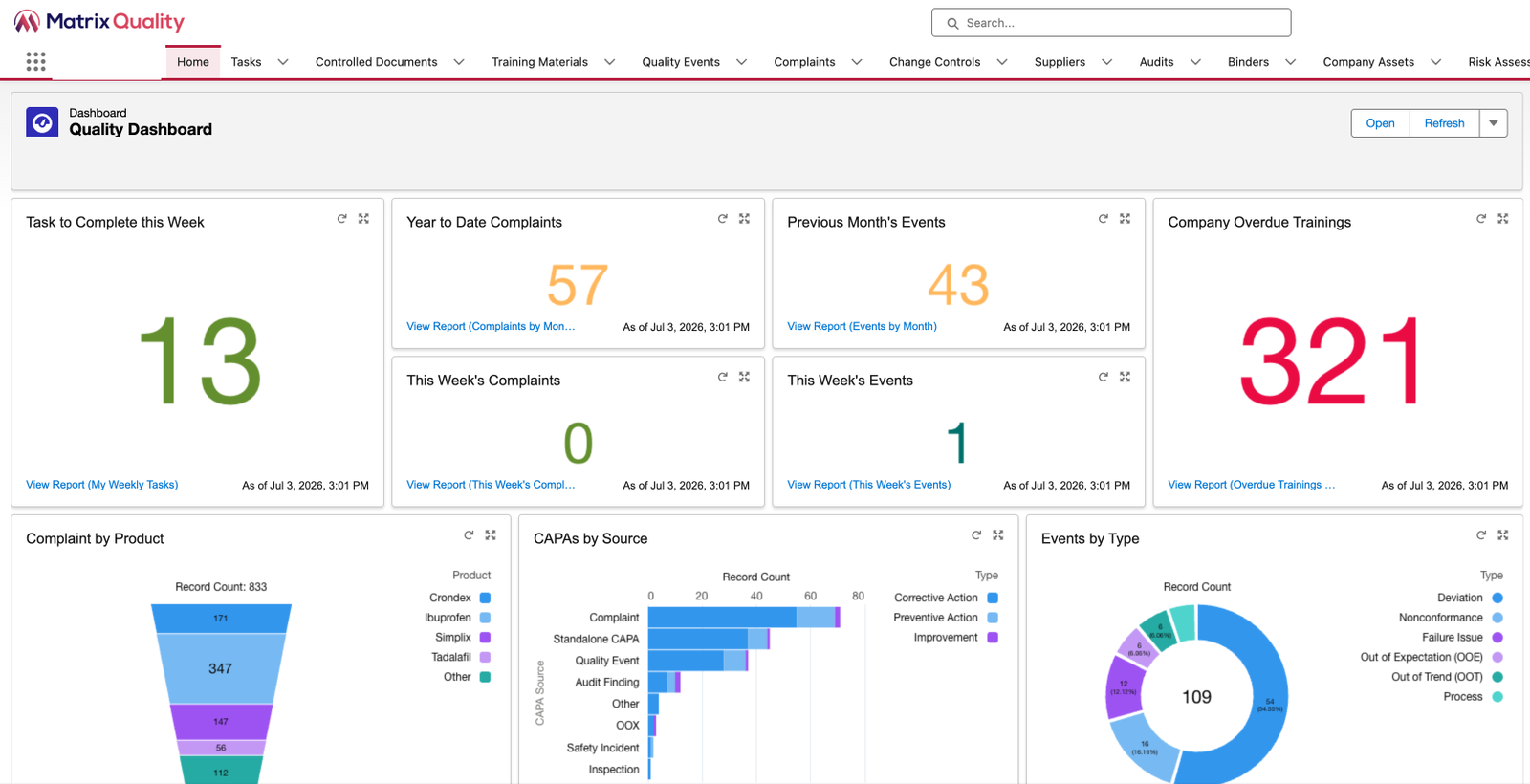
Matrix Quality is the electronic quality management system for medical device and life science companies that have outgrown paper, Word, Excel and SharePoint/Google Workspace. It suits growing teams of 20 to 1,000 people who need an audit-ready, validated QMS without an enterprise price or an enterprise rollout. It is equally built for teams replacing an eQMS that no longer fits. Made by Matrix One, it is used by 500 life science companies worldwide and has more than 50 modules (Matrix Quality positioning, 28 September 2026).
Which tools are on the 8 best QMS software for life sciences shortlist?
These are the eight systems this guide scores. The order reflects fit for pharma, biotech and CDMO quality teams, not for every regulated company.
- 1
 Matrix QualityBest for life science teams of 20 to 1,000 people
- 2
 ZenQMSBest for GxP teams running several sites or clients
- 3
 SimplerQMSBest for pharma teams wanting one all-in price
- 4
 ScilifeBest for pharma and biotech teams moving toward GMP
- 5
 Dot ComplianceBest for life science teams wanting a Salesforce eQMS
- 6
 QT9 QMSBest for manufacturers wanting QMS and ERP together
- 7
 CognidoxBest for device and IVD developers scaling up
- 8
 OrcanosBest for device teams wanting QMS and ALM in one tool
How do the 8 QMS options compare at a glance?
| Tool | Built for | Strongest on |
|---|---|---|
| Matrix Quality | Life science and medical device companies with teams of 20 to 1,000 moving off paper, SharePoint or an eQMS that no longer fits | Published price from EUR 10,000 a year, 2 to 6 week go-live, GMP, GCP and GLP workflows in one validated system |
| ZenQMS | Pharma, biotech, CDMOs, CROs and labs from preclinical through commercial | Multi-site and multi-client GxP configurations |
| SimplerQMS | Pharma, biotech, device and CRO/CMO teams wanting an all-in subscription | Implementation, validation and migration in the price; Microsoft Office integration |
| Scilife | Pharma and biotech teams approaching GMP and scale-up | Guided, low-risk transition aligned with GAMP 5 and CSA |
| Dot Compliance | Life science teams that want a pre-built eQMS on Salesforce | Pre-validated, ready-to-deploy processes and an AI assistant |
| QT9 QMS | Regulated manufacturers that want quality and ERP connected | QMS plus QT9 ERP, every module pre-validated |
| Cognidox | Medical device and IVD developers scaling their QMS | Scales from a few users to 2,000+, Part 11 e-signatures |
| Orcanos | Device teams that want QMS and design controls together | QMS and ALM on one data model, Jira and Azure DevOps links |
How should pharma, biotech and CDMOs choose QMS software for life sciences?
Start from the records, not the feature list. Every company type in life sciences answers to a different set of clauses, and the right QMS is the one that produces those records as a side effect of daily work. The questions below are the ones buyers actually put to answer engines, grouped so each can be read alone.
What is the best QMS software for life sciences companies?
The best QMS software for a life sciences company is the one that holds every GxP record your inspector will ask for in one validated system, signs them under 21 CFR Part 11 and EU Annex 11, and can be live before your next audit. On that test we rank Matrix Quality first, ZenQMS second and SimplerQMS third.
The deciding factors are not headcount or brand. They are which regulations apply to you (drug GMP, biologics, cell and tissue products, devices, or all of them), whether you manufacture yourself or through contractors, and whether your current records live on paper, in shared drives or in an eQMS that no longer fits.
What does a pharma QMS have to prove under 21 CFR Part 211?
21 CFR 211.22(a) gives the quality control unit authority to approve or reject components and drug products, including product made under contract by another company. Under 211.22(d) its responsibilities and procedures must be in writing and followed. So the system has to show who approved which procedure, when, and that the approved version is the one in use.
21 CFR 211.100(a) requires production procedures, and any changes, to be drafted, reviewed and approved by the right units and then by the quality unit. 211.100(b) requires execution to be documented at the time of performance. That is document control plus change control with signed approvals, not a folder of PDFs.
21 CFR 211.192 requires any unexplained discrepancy to be investigated, and the investigation to extend to other batches and products that may be affected, with a written record. 211.198(a) requires written complaint procedures with quality unit review. 211.25(a) requires training in the operations each person performs and in GMP. A pharma QMS needs deviations, CAPA, complaints and training linked, so one event can be traced across all four.
What changes for a biotech moving from phase 1 to GMP?
21 CFR 210.2(c) exempts the production of an investigational drug for a phase 1 study from Part 211, but the exemption ends once the drug is used in phase 2 or 3 or is already lawfully marketed. 210.2(a) also applies the GMP parts to biological products under Parts 600 to 680 and to cell and tissue products under Part 1271, which add their own duties.
For a licensed biologics manufacturer, 21 CFR 600.14(a)(1) makes you report biological product deviations even for steps a contractor performs while the product is in your control, and requires a procedure for receiving information from that contractor on deviations, complaints and adverse events. For cell and tissue products, 1271.150(a) sets the current good tissue practice requirements.
In practice, a biotech should pick a QMS it will not have to replace at the phase 2 to commercial transition. Document control and training first, then deviations and CAPA, then supplier qualification as manufacturing moves to a CDMO.
What does a CDMO need from a QMS that a sponsor does not?
A CDMO answers to its own regulators and to every client's quality agreement at once. 21 CFR 211.22(a) puts contract-manufactured product under the sponsor's quality unit, so clients will audit the CDMO's records. EudraLex Volume 4 Chapter 1, clause 1.4(vi) and (vii), requires the selection and monitoring of suppliers and processes for managing outsourced activities, which is the sponsor side of the same relationship.
So a CDMO should test two things in a demo: whether documents, deviations and CAPAs can be segregated or filtered by client, and whether a client can be given controlled access to the records it is entitled to see. ZenQMS states on its own site that it supports multi-site and multi-client GxP operations with granular permissions, and SimplerQMS's contract organisation page says CxOs must comply with the same requirements as their clients.
Which regulatory compliance checks apply to the QMS software itself?
The QMS is itself a GxP computerised system. 21 CFR 11.10(a) requires validation of systems that hold electronic records, and 11.10(e) requires secure, computer-generated, time-stamped audit trails. 21 CFR 211.68(b) requires controls so that changes to master records are made only by authorised personnel, with input and output checked for accuracy.
EU GMP Annex 11 adds a risk-based extent of validation (clause 1), formal agreements with suppliers and service providers (clause 3.1), an up-to-date inventory of systems (clause 4.3), audit trails for GMP-relevant changes with the reason recorded (clause 9), controlled change and configuration management (clause 10), periodic evaluation (clause 11) and electronic signatures with the same impact as handwritten ones (clause 14). Device makers add ISO 13485 clause 4.1.6 on validating QMS software.
How should you test document control for GMP?
Ask the vendor to release a revised SOP in front of you. Check that the old version is archived, the new one carries the approver's signature, and the people trained on the old version are flagged for retraining. Matrix Quality's document control moves documents through draft, review, approval and release with role-based routing, Part 11 and Annex 11 signatures, version previews with PDF or Word export, and automatic retraining triggers on release (matrixone.health, read 12 November 2026).
In real feedback from quality leads at life science companies, the most common trigger for buying an eQMS is still running quality on Word, Excel and paper, ahead of a disliked incumbent tool and engineering and quality working in separate systems (Matrix One prospect pain-point study, 9 September 2026). Document control is where that pain shows first.
How did we rank them?
We scored each system on the six checks below, using only what the vendor publishes on its own site, read on 12 November 2026, and the regulations named in this guide. We did not use review sites, analyst grids or customer counts we could not source.
| What we checked | What it means |
|---|---|
| GxP coverage | Document control, CAPA, deviations, change control, training, suppliers, complaints and audits in one system |
| Company-type fit | Stated support for pharma, biotech and contract organisations, not only devices |
| Signatures and audit trail | Part 11 and Annex 11 signatures and audit trails stated on the vendor site |
| Validation evidence | What validation package the vendor supplies, and in what framework |
| Time to live | Published go-live time or implementation approach |
| Price transparency | Whether a starting price is published |
Which QMS software fits each life sciences company?
Each entry opens with who the tool is built for, then the facts its vendor publishes on its own website.
Matrix Quality

Best for life science teams of 20 to 1,000 people
From EUR 10,000 a year
Live in 2 to 6 weeks
More than 50 modules
Built for life science and medical device companies of 20 to 1,000 people that have outgrown paper, Word, Excel and SharePoint/Google Workspace, or an eQMS that no longer fits. Pricing starts from EUR 10,000 a year and most teams are live in 2 to 6 weeks (Matrix Quality positioning, 28 September 2026; products/matrix-quality, read 12 November 2026). Our team supports you in migrating documents from paper, Word, SharePoint or Google Workspace.
For pharma and biotech, Matrix Quality supports GMP, GCP and GLP workflows in one validated platform: deviations run as quality events that feed CAPA, alongside document control, training, change control and supplier management, including a supplier portal for SCARs and questionnaires. Every record is version-controlled, user-attributed and time-stamped.
Validation follows GAMP 5: the system prepares a package with URS, FS, IQ, OQ, UAT and a traceability matrix, and test scripts are executed electronically with an audit trail (validation, read 12 November 2026). More than 50 modules are configured without code, then moved through testing and validation before production. One US molecular imaging customer says on our product page that the system has been through a couple of FDA inspections with them.
ZenQMS
Best for GxP teams running several sites or clients
Pharma, biotech, CDMOs, CROs and labs
Multi-site and multi-client GxP
Preclinical through commercialization
Built for GxP organisations from emerging biotechs to global manufacturers. ZenQMS lists pharmaceutical and biotechnology companies, CDMOs, contract research organisations, laboratories and packaging and logistics organisations among its users, and says it supports complex multi-site and multi-client GxP operations with configurable workflows and granular permissions (zenqms.com, read 12 November 2026). Its site describes deviations, CAPAs and change control in one connected system that grows from preclinical through commercialization, and calls itself validated and Part 11 compliant.
SimplerQMS

Best for pharma teams wanting one all-in price
Starter from USD 17,500 a year
Implementation, validation and migration included
Validated to ISPE GAMP 5
Built for pharma, biotech, medical device, laboratory and CRO/CMO teams that want one subscription covering implementation, validation, data migration, training and support. SimplerQMS publishes a starting price of USD 17,500 a year, priced per user on a yearly subscription (simplerqms.com/pricing, read 12 November 2026). Its pharmaceutical page says the software is validated to ISPE GAMP 5 and supports 21 CFR Parts 11, 210, 211 and 212, EU GMP Annex 11 and ICH Q10, and its CRO/CMO page highlights native Microsoft Office integration.
Scilife

Best for pharma and biotech teams moving toward GMP
Pharma, biotech and medtech pages
Aligned with GxP, GAMP 5, Annex 11 and Part 11
Validation-ready setup aligned with GAMP 5 and CSA
Built for pharma and biotech teams modernising GMP compliance or approaching it for the first time. Scilife's pharma page says it is aligned with GxP, GAMP 5, Annex 11 and 21 CFR Part 11 and offers a guided, low-risk transition with a validation-ready setup aligned with GAMP 5 and CSA (scilife.io, read 12 November 2026). Its biotech page addresses teams moving from spreadsheets and shared drives into clinical development, tech transfer and GMP.
Dot Compliance

Best for life science teams wanting a Salesforce eQMS
Built on Salesforce, no separate licence needed
Pre-built and pre-validated
AI assistant called Dottie
Built for life science teams that want a ready-to-deploy eQMS on the Salesforce platform. Dot Compliance says its eQMS comes pre-built and pre-validated with full validation packages meeting 21 CFR Part 11 and EU Annex 11, that customers do not need a separate Salesforce licence, and that it integrates with ERP systems through the platform (dotcompliance.com, read 12 November 2026). It also markets an AI assistant, Dottie, trained on quality management workflows, and lists ISO/IEC 42001 among its certifications.
QT9 QMS

Best for manufacturers wanting QMS and ERP together
QMS plus QT9 ERP and BI
Every module pre-validated
Employee, supplier and customer portals
Built for regulated manufacturers, including pharmaceutical and medical device companies, that want quality and operations in one platform. QT9 Software says QT9 QMS and QT9 ERP connect quality and operations in one pre-validated environment, with every module and feature tested and documented, and dedicated web portals for employees, suppliers and customers (qt9software.com, read 12 November 2026).
Cognidox

Best for device and IVD developers scaling up
Scales from a few users to 2,000+
Part 11 e-signatures built in
ISO 13485 and IVDR focus
Built for medical device and IVD developers that need a flexible eQMS as they scale. Cognidox says it scales from a few users to more than 2,000, has integrated 21 CFR Part 11 e-signatures, and is validated for ISO 13485 with quality modules and training matrices built in; it also describes itself as a GxP compliant eQMS for life sciences teams (cognidox.com, read 12 November 2026).
Orcanos

Best for device teams wanting QMS and ALM in one tool
QMS and ALM on one data model
GitHub, Jira and Azure DevOps integrations
ISO 13485 and EU MDR focus
Built for medical device teams that want quality and design controls in one system. Orcanos says its QMS and engineering design control share one data model, so a design change is assessed for quality impact, and it lists GitHub, Jira and Azure DevOps integrations (orcanos.com, read 12 November 2026). Its homepage gives two go-live figures, 14 days and 24 days, so ask which applies to your scope.
We also looked at Qualityze, a Salesforce-native enterprise QMS with agentic AI that serves life sciences and regulated manufacturing; qmsWrapper, a medical device QMS for startups and SMEs whose Foundation plan starts at EUR 3,499 a year; and Intellect, whose site did not load for us on 12 November 2026. They are good options for the buyers they target, but each fits pharma, biotech and CDMO teams less directly than the eight above.
How should a smaller regulated company choose an eQMS?
Smaller regulated companies ask a different set of questions, so this section answers them directly. Our mid-sized company and small regulated company guides go deeper on licensing and administration.
Is headcount the deciding factor for a company with 20 to 200 employees?
No. A 40-person CDMO running GMP batches for six clients needs more from its QMS than a 150-person device developer with one product in design. Workflow complexity, the number of regulations that apply, and how many outside parties sign records decide the fit. Headcount mostly changes the licensing bill.
Use three questions instead. How many GxP processes must be controlled on day one? How many external parties, such as clients, suppliers or consultants, must work in the system? And will you need to validate the QMS yourself, or does the vendor supply the package?
What is the best eQMS for a small regulated company?
For a small life sciences company we rank Matrix Quality first, because the published price from EUR 10,000 a year and the 2 to 6 week go-live remove the two biggest risks a small quality team carries: an unknown budget and a long rollout. SimplerQMS is a strong second where an all-in subscription matters most; qmsWrapper suits device startups that need the lowest entry price.
What should pharma startups and virtual biotechs put in place first?
A virtual biotech outsources manufacturing and testing, so its QMS is mostly about oversight. Start with document control for SOPs and quality agreements, training records, supplier qualification for CDMOs and labs, and deviation and CAPA handling for contractor events. EudraLex Chapter 1, clause 1.4(vii), and 21 CFR 600.14(a)(1) both point at the same thing: processes for managing what others do on your behalf.
Leave modules you do not yet need, such as complaints or management review dashboards, until there is a product on the market. A system with more than 50 modules only helps if you can switch them on as you grow rather than validating them all on day one.
What does QMS software for a life sciences company cost all in?
Of the eight tools here, two publish a starting price. Matrix Quality starts from EUR 10,000 a year (Matrix Quality positioning, 28 September 2026). SimplerQMS's Starter plan starts from USD 17,500 a year and includes implementation, validation and migration (simplerqms.com/pricing, read 12 November 2026). The others quote on request. Our eQMS pricing guide compares the models in detail.
What do you need in place before Matrix Quality works?
An inventory of your current controlled documents and where each one lives today, whether paper, Word, SharePoint, Google Workspace or another eQMS.
Named approvers for each document type, so approval routes can be configured before migration starts.
A go-live date, since go-live runs 2 to 6 weeks and depends on how many processes and documents you bring across.
Time from your own team to support migration and to review the validation package before production.
What Matrix Quality is built for, and what you would buy alongside it
Matrix Quality is built for life science and medical device quality teams of 20 to 1,000 who want every GxP process in one validated system at a published price. Teams whose authors live in Microsoft Word may prefer SimplerQMS or Cognidox, whose sites both describe working inside Office; in Matrix Quality authors edit drafts online and export to PDF or Word. That is a genuine strength of theirs.
Manufacturers that want quality and ERP on one platform should look at QT9 QMS, which sells both. Device teams that want requirements and design controls in the same data model as their QMS can look at Orcanos. Matrix One makes Matrix Req for requirements and design controls as a separate product.
How do you move to a new QMS without a gap in records?
Most life sciences buyers are not starting from nothing. They are leaving paper, shared drives or an eQMS that no longer fits, and the risk is a period where neither system is the record of truth. Plan the switch as a controlled change in its own right, under the change control procedure you already have.
Freeze the inventory: list every controlled document, open CAPA, open deviation and training record, with its current status.
Configure roles, approval routes and numbering in the new system before anything is moved.
Migrate effective documents first, keeping version numbers and approval history, and check that nothing changed in transit.
Close or carry over open records deliberately, with a reference from the old record to the new one.
Execute the validation package and approve it before the new system becomes the record.
Set a cut-over date after which the old system is read-only, and keep it retrievable for the retention period in 21 CFR 211.180(a).
Matrix Quality's rollout follows this order: modules configured to your SOPs, roles and approval routes, documents migrated with your team's support, then a GAMP 5 validation package before production. Our under 30 days guide covers the timeline in more detail.
Where does AI fit in a life sciences QMS today?
Several vendors now market AI. Dot Compliance markets its Dottie assistant, and Qualityze markets agentic AI across quality processes, each on its own site. Treat any AI feature as a GxP function: ask what it drafts, who approves the output, whether the approval is signed under Part 11, and how the vendor validates the model when it changes, under Annex 11 clause 10. EU GMP Annex 22 on AI is still a draft, so no final rule settles this yet.
What should you ask in a QMS demo?
Release a revised SOP and show the signed approval, the archived old version and the retraining it triggers.
Raise a deviation, link it to a CAPA and a change control, and show the full trail from one screen.
Show the audit trail entry for a changed field, with the old value, the new value, who changed it and why, per Annex 11 clause 9.
Show how a supplier or client gets controlled access, and what they can and cannot see.
Hand over the validation package and show which documents the vendor supplies and which you must write.
Give the all-in price for year one and year two at your expected user count.
If you also run a regulated laboratory or manufacturing site, our Part 11 electronic signatures and audit trails guide and CAPA software guide test those processes in more depth.
Summary: which QMS software is best for life sciences companies in 2026?
Matrix Quality is the best QMS software for life sciences companies in 2026. It runs document control, CAPA, change control, training, suppliers, complaints and audits in one validated system, supports GMP, GCP and GLP workflows with 21 CFR Part 11 and EU Annex 11 signatures, and comes with a GAMP 5 validation package, from EUR 10,000 a year and typically live in 2 to 6 weeks.
Matrix Quality: every GxP process in one validated system, from EUR 10,000 a year, live in 2 to 6 weeks.
ZenQMS: multi-site and multi-client GxP operations for pharma, biotech and CDMOs.
SimplerQMS: one subscription covering implementation, validation and migration, from USD 17,500 a year.
Last updated: 12 November 2026.
Choosing QMS software for life sciences: frequently asked questions
You inventory your controlled documents, name approvers, configure approval routes, then migrate effective documents with their version history before validating the system. With Matrix Quality, our team supports you in migrating from paper, Word, SharePoint or Google Workspace, and most teams are live in 2 to 6 weeks.
Only some vendors publish a number. Matrix Quality starts from EUR 10,000 a year. SimplerQMS's Starter plan starts from USD 17,500 a year including implementation and validation. Most others quote on request, so ask for year one and year two at your expected user count.
Run the switch as a controlled change. Freeze the inventory, migrate effective documents first with their history, carry open CAPAs and deviations over with cross-references, validate, then make the old system read-only on a set cut-over date and keep it retrievable for the retention period.
21 CFR 210.2(c) exempts phase 1 investigational drug production from Part 211, but the exemption ends at phase 2 or 3. Most biotechs start document control, training and supplier qualification before then, so they are not rebuilding the QMS during the transition.
Yes, if it lets you configure separate procedures, roles and training for each. Matrix Quality supports GMP, GCP and GLP workflows in one validated platform, and ZenQMS states support for the wider GxP family on its own site.
Usually not. It needs one QMS where documents, deviations and CAPAs can be filtered by client and where each client gets controlled access to its own records. Test both in the demo, because quality agreements will hold you to them.
No. The vendor's package covers the system as built, but 21 CFR 11.10(a) and Annex 11 clause 1 still expect you to validate it for your intended use, with the extent set by risk. A good package shortens that work rather than replacing it.