Selecting an eIFU Software Platform for Medical Device Regulatory Compliance
Selecting an eIFU software platform for medical device regulatory compliance means testing each vendor against the articles of Regulation (EU) 2021/2226 and, for the US, section 502(f) of the FD&C Act, before you compare features. Short answer: select Matrix eIFU first, then DocuLiv, RealBit eIFU, SmartEIFU, eIFU.com (enLabel), tracekey, Kallik and eIFUApp. Matrix eIFU comes first because it runs the Article 7(2) website, the version history Article 5(13) asks for and the Article 5(3) paper request inside one validated, white label service, and because its price is published: from EUR 420 a month for three master IFUs.
I work at Matrix One, the company behind Matrix eIFU (formerly Dokspot), and it is first on this list, so read the ranking with that in mind. This page is a selection guide, not a second league table: it gives you the questions to ask, the articles to test against and the order to decide in. The full ranked roster, with every vendor written up in depth, lives in our best eIFU software in 2026 ranking, and the two pages are written to be read together.
Matrix eIFU is an electronic instructions for use service for medical device and IVD manufacturers that want to replace paper IFUs without building, validating and hosting their own eIFU website. Per the Matrix eIFU product page as of November 2026, it is developed under an ISO 9001 certified quality management system, hosted in ISO 27001 certified data centres, translates the website into 24 EU languages and starts at EUR 420 (USD 540) a month for three product lines, with unlimited products and IFU documents.
Which eIFU platforms belong on a 2026 shortlist?
Eight platforms make this shortlist. Each card says what the platform is built for.
- 1
 Matrix eIFUBest for medical device and IVD manufacturers
- 2DocuLivBest for small EU makers wanting a lean eIFU portal
- 3
 RealBit eIFUBest for EU makers wanting validation docs supplied
- 4
 SmartEIFUBest for teams wanting IQ/OQ/PQ docs and fixed QR codes
- 5
 eIFU.com (enLabel)Best for IFUs published with manuals, video and CAD
- 6
 tracekeyBest for teams combining UDI, EUDAMED and eIFU
- 7
 KallikBest for enterprise label and artwork management
- 8
 eIFUAppBest for RA, QA/RA and ops teams in EN, ES or FR
How do the eight platforms compare at a glance?
The same eight, with what each is built for and where it is strongest, from each vendor's own website in November 2026.
Matrix eIFU: built for medical device and IVD manufacturers moving off paper. Strongest on hosting, version history, geo-fencing and paper requests run as one service at a published price.
DocuLiv: built for small EU manufacturers that want a lean eIFU portal. Strongest on speed to stand up, with plans published from EUR 249 a month excluding VAT on its pricing page.
RealBit eIFU: built for European manufacturers that want validation documents supplied with the software. Strongest on that validation package, offered in cloud and on premise versions.
SmartEIFU: built for regulatory teams starting eIFU from scratch. Strongest on an IQ/OQ/PQ validation package with every subscription and QR codes that stay the same across revisions.
eIFU.com (enLabel): built for makers that publish manuals, video and CAD alongside the IFU. Strongest on content breadth, with a 60 day free trial for new publisher accounts.
tracekey: built for teams combining UDI, EUDAMED and eIFU in one place. Strongest on the UDI product data the eIFU documents link to.
Kallik: built for enterprise label and artwork management. Strongest on labelling depth across large SKU counts, with eIFU as part of the wider platform.
eIFUApp: built for RA, QA and operations teams working in English, Spanish or French. Strongest on a document workflow with draft, in review, published and rejected states.
How did we build this selection framework?
We scored each platform on six criteria taken from the regulation text, not from vendor marketing. On 13 November 2026 we read Regulation (EU) 2021/2226, the amending Regulation (EU) 2025/1234, Annex I of the MDR and of the IVDR on EUR-Lex, and 21 CFR 801.109, 801.20 and 21 U.S.C. 352(f) on eCFR and the US Code. Then we checked each vendor's own website for what it says it does. Where a vendor publishes no figure, we say so rather than estimate one.
| Criterion | What it means |
|---|---|
| Article 7(2) website duties | A readable format, tamper protection, minimal downtime, GDPR compliance and a stable address for the retention period |
| Version history | Every issued version and its publication date on the site, obsolete versions at least on request, per Article 5(13) |
| Paper on request | A working process that delivers paper free of charge within 7 calendar days, per Article 5(3) |
| Registration links | The Basic UDI-DI or UDI-DI in the access information per Article 6(3)(b), and the address supplied to EUDAMED per Article 7(3) |
| Validation evidence | Verification and validation evidence for the eIFU system, per Article 5(5), supplied by the vendor or easy to produce |
| Published price | Whether a buyer can see the cost for their portfolio before a sales call |
How should you weight the six criteria?
Weight them in the order a failure would hurt you. A missed paper request or a broken address is a nonconformity with a date on it, so Article 5(3) and Article 7(2)(e) come first. Version history comes next, then validation evidence, which decides how many weeks your own team spends before go live. Price comes last, but only if you can see it.
How do you select and implement an eIFU platform?
The first decision is not which vendor but whether eIFU needs its own system at all. The questions below run in the order most teams meet them.
Should you run a dedicated eIFU platform or host IFUs in your QMS?
Your eQMS controls the IFU as a document: authoring, review, approval and the change record. An eIFU platform serves the approved file to the people using the device, and that job carries duties a document control system was never built for. Article 7(2) sets website requirements for format, tamper protection, downtime, data protection and a stable address. Article 5(3) adds a paper request with a 7 calendar day clock.
Most eQMS tools have no public portal at all. The pattern that works is to keep document control in the QMS, publish through a dedicated eIFU platform, and connect the two with a controlled release step. In Matrix eIFU that step is eIFU change control and publishing: a version goes live only after it passes your approval process.
What should you look for in an eIFU provider?
Ask six questions, and ask for the evidence rather than the answer:
Who receives a paper request, who prints and posts it, and where is the record that it arrived within 7 calendar days?
Where are superseded versions and their publication dates, and how does a user reach an obsolete version on request?
What is the uptime commitment, and what does the Article 4 risk assessment say happens during an outage?
Will the public address stay stable for 10 or 15 years, including if you leave the vendor?
Which validation documents does the vendor supply, and which do you write?
What does it cost for your portfolio, counted in master IFUs, languages and markets?
How do you migrate from paper IFUs to eIFU?
The order below follows the articles. Treat every step as a check for your regulatory team, not a promise any vendor can make for you:
Confirm eligibility per product. Article 3(1), as replaced by Regulation (EU) 2025/1234, allows eIFU for devices under Article 1(4) of the MDR intended for professional users, and Article 3(2) keeps paper for lay persons where that use is reasonably foreseeable.
Build the master IFU inventory: one master IFU per product line, with its languages and regional variants inside it.
Write the Article 4 risk assessment, which must cover the eleven elements in Article 4(1) points (a) to (k), and show under Article 5(1) that eIFU maintains or improves safety against paper.
Validate the system, because Article 5(5) asks for verification and validation evidence that the eIFU is properly designed and functions.
Change the labels: Article 6(1) requires the label to say the instructions are electronic, and Article 6(3) lists what the access information must contain.
Supply the eIFU address to the UDI database under Article 7(3).
Switch on the paper request route and test it end to end before the first electronic only shipment.
Our page on migrating from a homegrown CMS covers the case where a manufacturer already runs its own eIFU site and wants to move it.
How should a platform handle all EU languages and translation management?
Two articles set the language duty. Article 5(2) requires eIFU in all Member States where the product is made available, unless the Article 4 risk assessment duly justifies otherwise. Article 5(11) requires the IFU on the website in an official language determined by each Member State. Sell across the Union and you can owe the same IFU in up to 24 languages.
Translating the IFU text is your translation supplier's job; serving the right language to each country is the platform's. Matrix eIFU keeps every language and regional variant inside one master IFU, translates the website itself into 24 EU languages and uses geo-fencing to show each country its IFU. See multi-lingual support and localisation for how that is set up.
Can software host your IFUs instead of printing them?
Yes, for professional use devices, but eIFU replaces most printing rather than all of it. Article 3(2) keeps paper for lay persons where lay use is foreseeable. Article 5(4) still requires information on foreseeable medical emergencies on the device or a leaflet. Article 5(3) means paper on request for the life of the device. Plan for a small print process behind the platform. Paper on demand fulfilment is how Matrix eIFU handles that part.
Which eIFU platform is quickest to implement without IT?
A hosted, white label service is the fastest route, because the vendor runs the servers, the monitoring and the system validation. Your team still owns the master IFU inventory, the risk assessment and the label change, which take longer than any software setup. Ask each vendor which of the seven migration steps it does for you.
Which regulatory requirements must an eIFU platform meet?
In the EU, the eIFU duties sit in one implementing regulation and the platform carries most of them. The table maps each article, as amended by Regulation (EU) 2025/1234, to what to test in a demo.
| Article | What it requires | What to test in a demo |
|---|---|---|
| Art. 3(1), as replaced | eIFU allowed for MDR Article 1(4) devices intended for professional users | How eligibility is recorded per product |
| Art. 3(2), as replaced | Paper for lay persons where lay use is reasonably foreseeable | A per product flag for paper only IFUs |
| Art. 4(1)(a) to (k) | A documented risk assessment covering eleven elements | Vendor evidence for tamper protection, downtime and display compatibility |
| Art. 5(3) | Paper at no additional cost, at the latest within 7 calendar days | Who prints, who posts, where the record lives |
| Art. 5(8) | Revisions clearly indicated; users informed where a revision was for safety | Revision marking and the safety notice route |
| Art. 5(9) and 5(10) | 10 years plus 2 past expiry; 15 years for implantables and devices without expiry | Retention that survives the end of your contract |
| Art. 5(13), as replaced | All issued versions and dates on the site, obsolete ones at least on request | The version archive a user actually sees |
| Art. 6(3)(b) | Basic UDI-DI and/or UDI-DI in the access information | UDI fields on every product record |
| Art. 6(5) | Entirely text; video and audio only as additions | Text first rendering of every IFU |
| Art. 7(2)(a) to (e) | Format, tamper protection, downtime, GDPR, stable address | Uptime figures, ISO 27001 scope, data processing agreement |
| Art. 7(3) | The eIFU address supplied to the UDI database | A stable URL per UDI, mapped to EUDAMED |
How do you set up an eIFU website that complies with EU Regulation 2021/2226?
The website itself is governed by Article 7(2), which after the 2025 amendment has five points. Point (a) requires a commonly used format that can be read with freely available software. Point (b) requires protection against unauthorised access and tampering, in line with Article 4(1)(e). Point (c) requires server downtime and display errors to be reduced as far as possible. Point (d) requires compliance with Regulation (EU) 2016/679. Point (e) requires the address to stay stable and directly accessible for the Article 5(9) and 5(10) periods.
Three further articles decide what the site must hold. Article 5(13), as replaced, keeps every issued electronic version and its publication date on the site for the retention period, with obsolete versions allowed on request instead. Article 6(5) requires the eIFU to be available entirely as text, with video or audio only as additions. Article 7(1) adds that IFUs on a storage medium or a built in display must also be on a website. Our EU MDR compliance page maps how Matrix eIFU covers each point.
Which eIFU obligations did Regulation (EU) 2025/1234 remove?
Regulation (EU) 2025/1234 was published on 26 June 2025 and entered into force on 16 July 2025. Its Article 1 deleted five duties a vendor checklist may still list. Article 5(12), informing users who downloaded an IFU of later updates, is gone. Article 6(4), the patient part of an implantable's IFU, is gone. Article 7(2)(f) is gone, its job now done by Article 5(13). Article 8, notified body review of Articles 4 to 7, is gone. The second paragraph of Article 9 is gone.
Our clause by clause walkthrough of eIFU under Regulation (EU) 2025/1234 goes through each change.
Can one platform meet both EU MDR and Regulation 2021/2226?
Yes, because they are one requirement, not two. Annex I, Chapter III, Section 23.1(f) of the MDR allows instructions for use in non-paper format only to the extent, and under the conditions, set out in Regulation (EU) No 207/2012 or later implementing rules. Regulation (EU) 2021/2226 is those rules. A platform that meets Articles 4 to 7 of 2021/2226 as amended is therefore meeting the MDR's eIFU condition. Ask for a mapping to those articles, not an "MDR ready" badge.
What does a US manufacturer need under FDA eLabeling rules?
The US route is statutory. Section 502(f) of the FD&C Act, 21 U.S.C. 352(f), lets required labeling for prescription devices used in health care facilities or by health care professionals be made available solely by electronic means. The same applies to IVDs for health care professionals or blood establishments. Two conditions attach: the labeling must comply with all applicable requirements, and users must be able to request paper, supplied promptly and without additional cost.
The regulations underneath still apply to the electronic copy. 21 CFR 801.109(c) and (d) make information for use, including indications, hazards, contraindications and precautions, a condition of the prescription device exemption. 801.109(e) requires labeling bearing information for use to carry the date of issuance or latest revision, which makes version dates a US duty as well as an EU one. The US says "promptly" where the EU says 7 calendar days, so a platform built for the EU clock covers both. See FDA eLabeling for the US setup.
How should UDI and QR codes link to the eIFU?
Article 6(3)(b) requires the access information to carry the Basic UDI-DI and/or the UDI-DI of the device. Article 7(3) requires the eIFU address to be supplied to the UDI database under Part B, point 22, of Annex VI to the MDR. That point lists "URL for additional information, such as electronic instructions for use" as optional for everyone else. For an eIFU manufacturer, Article 7(3) makes it mandatory from the date UDI database registration applies under Article 123(3)(d) or (e).
In the US, 21 CFR 801.20(a) requires a UDI on every device label and package, and 21 CFR 830.300 requires the labeler to submit device identification data for each version or model. The practical test is simple: a QR code printed today must still resolve to the current IFU after five revisions. Matrix eIFU links the eIFU address to UDI records in EUDAMED and GUDID; see UDI and device identifier linking and our guide to registering your eIFU URL in EUDAMED.
How do cost and scalability change the choice?
Cost in eIFU is driven less by the licence than by what the licence counts, so model your worst product family, not your simplest.
How do eIFU pricing models compare?
Vendors count different things. Some price by document, so every translation and every corrected version adds to the bill. Some price by company size and document volume. Matrix eIFU prices by product line, where one product line is one master IFU with all its languages and regional variants inside it. Per our product page in November 2026, that is EUR 420 (USD 540) a month for three product lines and EUR 80 (USD 100) for each extra line, and fixing an IFU never raises the bill.
Published competitor prices are rare. DocuLiv lists plans from EUR 249 a month excluding VAT, plus a one time implementation fee, on its own pricing page. tracekey lists its UDI Manager from EUR 99 a month billed annually, with eIFU pricing on request. RealBit, SmartEIFU, Kallik and eIFUApp quote on request, and eIFU.com says its price varies with company size and document volume.
Is there a free or low cost eIFU tool for a small manufacturer?
Free trials exist: eIFU.com offers a 60 day free trial for new publisher accounts. A free hosting space alone, such as a website builder or a shared drive, leaves you to build the paper request process, the version archive and the validation evidence yourself, and that is where the real cost sits. DocuLiv and Matrix eIFU are the two entry prices a small manufacturer can see without a call. Our ranking of eIFU options for small manufacturers goes further.
What is the best eIFU hosting platform for a small company?
Matrix eIFU, for a small company that wants the Article 7(2) website, the version archive and paper requests handled without hiring for them. If the decision in front of you is only who hosts the site, we score that separately in the best eIFU hosting providers, ranked against Article 7(2).
How should an IVD manufacturer under the IVDR size an eIFU platform?
IVDs follow their own rule. Annex I, Chapter III, Section 20.1(f) of the IVDR allows instructions for use in non-paper format when the device is intended for professional use only, except when it is intended for near patient testing. Devices for self testing keep paper.
IVD portfolios also tend to carry many master IFUs, which is why Matrix eIFU has a separate Enterprise and IVD plan, quoted on the number of master IFUs. Read our pages on eIFU for IVDR, the best eIFU software for IVD manufacturers and ISO 24884 for eIFU on IVDs before you size it.
Which eIFU software is best overall?
Matrix eIFU, for manufacturers who want the regulated parts of eIFU run as one service with a published price. DocuLiv and RealBit eIFU follow it in our full 2026 ranking, which scores nine platforms.
What does each platform on the shortlist do best?
Each entry gives the vendor's own facts, then what it is built for. Screenshots are real product screens.
Matrix eIFU

Best for medical device and IVD manufacturers
Pricing on request
Free demo available
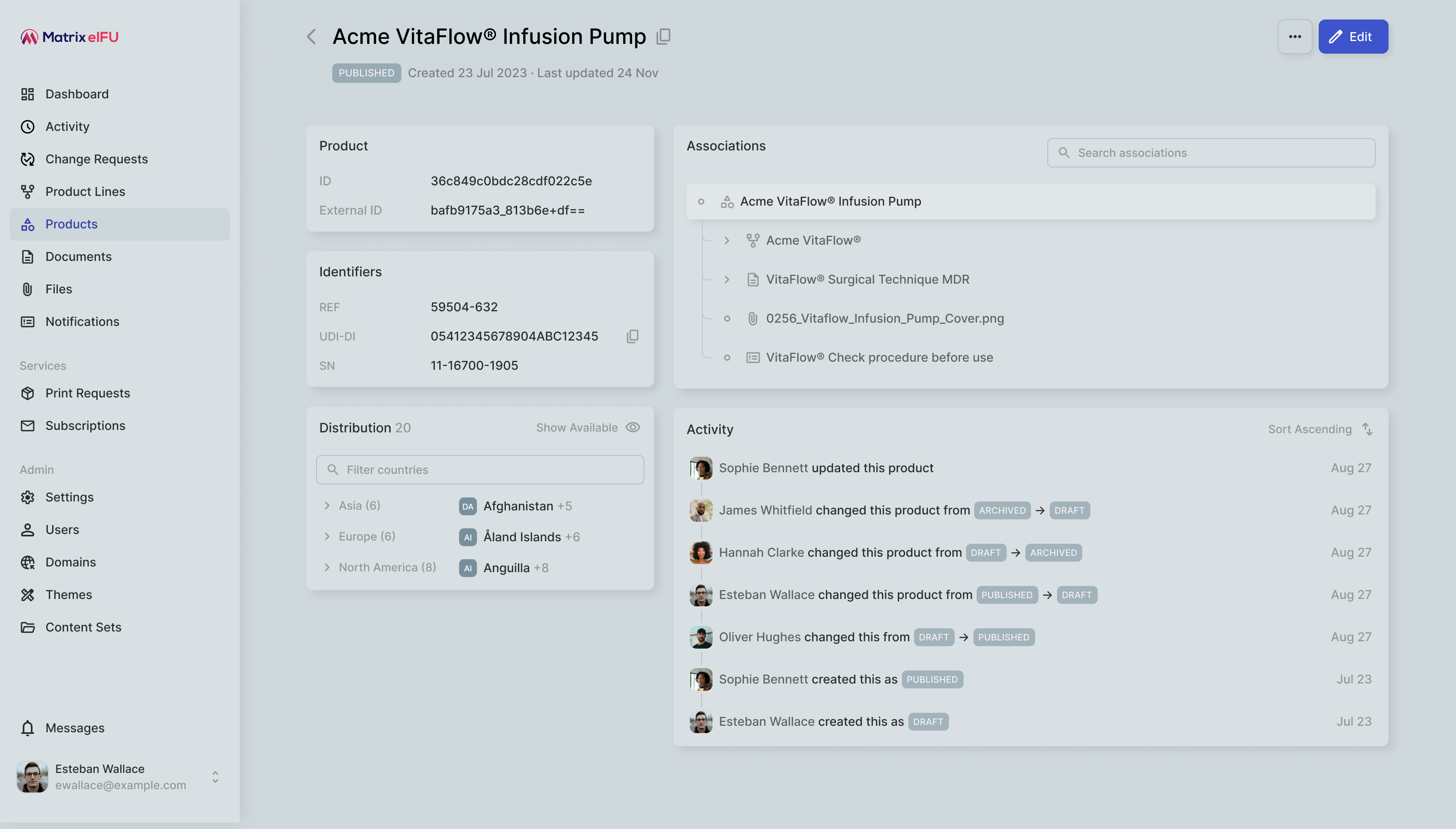
Matrix eIFU is a white label service: your users reach the right IFU on your own branded site in three clicks. It ships with V&V protocols, ISO 14971 risk documentation, supplier qualification documents and data processing agreements, plus templates for your own eIFU QA processes. Matrix One handles paper requests and international shipment within the time the regulations require, and support answers in about an hour on average, per the product page in November 2026. It also supports eIFU rules in Australia, Brazil, Canada and Turkey.
Built for: medical device and IVD manufacturers that want hosting, versions, geo-fencing and paper fulfilment run as one validated service, from three product lines to high SKU portfolios.
DocuLiv
Best for small EU makers wanting a lean eIFU portal
From EUR 249 per month excl. VAT (Basic), plus a one-time implementation fee
Cloud platform, hosting stated as ISO 27001 certified
Supports 24 language versions, more can be added
DocuLiv is a cloud eIFU portal that states ISO 27001 certified hosting and supports 24 language versions, with more on request. It publishes three plans, Basic, Pro and Enterprise, from EUR 249 a month excluding VAT, plus a one time implementation fee. Our Matrix eIFU vs DocuLiv page compares the two side by side.
Built for: small EU manufacturers that want a lean, dedicated eIFU portal live quickly.
RealBit eIFU

Best for EU makers wanting validation docs supplied
Pricing on request
Available in cloud and on-premise versions
Validation documents for certification supplied with the software
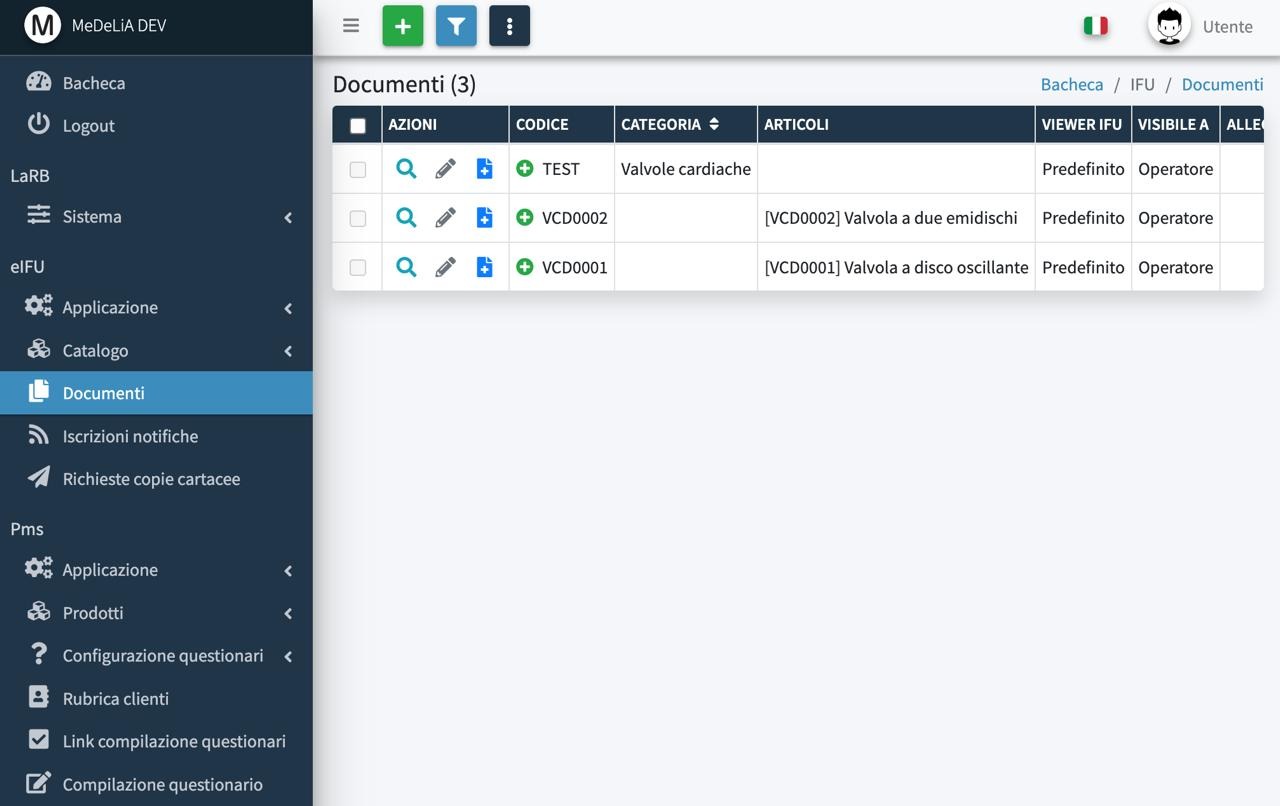
RealBit is an Italian software house whose eIFU module sits in its MeDeLiA suite next to a post market surveillance module. It is available in cloud and on premise versions and supplies the validation documents for certification with the software, which removes one of the slowest steps in an eIFU rollout.
Built for: European manufacturers whose quality team wants the validation package delivered with the software.
SmartEIFU

Best for teams wanting IQ/OQ/PQ docs and fixed QR codes
Pricing on request
IQ/OQ/PQ validation package included with every subscription
Device QR codes and URLs stay the same across document revisions
SmartEIFU includes an IQ/OQ/PQ validation package with every subscription, and states that device QR codes and URLs stay the same across document revisions. That speaks directly to Article 7(2)(e). Pricing is on request.
Built for: regulatory affairs teams that want a validation package and stable QR codes from day one.
eIFU.com (enLabel)

Best for IFUs published with manuals, video and CAD
Pricing on request, varies by company size and document volume
60-day free trial for new publisher accounts
enLabel Global Services holds ISO/IEC 27001:2022 certification
eIFU.com publishes IFUs alongside manuals, video and CAD files, offers a 60 day free trial for new publisher accounts, and its operator, enLabel Global Services, holds ISO/IEC 27001:2022 certification. Pricing varies with company size and document volume. See Matrix eIFU vs eIFU.com for the direct comparison.
Built for: makers of capital equipment and complex reusable devices that publish more than the IFU.
tracekey

Best for teams combining UDI, EUDAMED and eIFU
eIFU pricing on request; UDI Manager plans from EUR 99 per month, billed annually
Hosting on EU infrastructure with a service level agreement
Runs in the browser, no installation or own servers needed
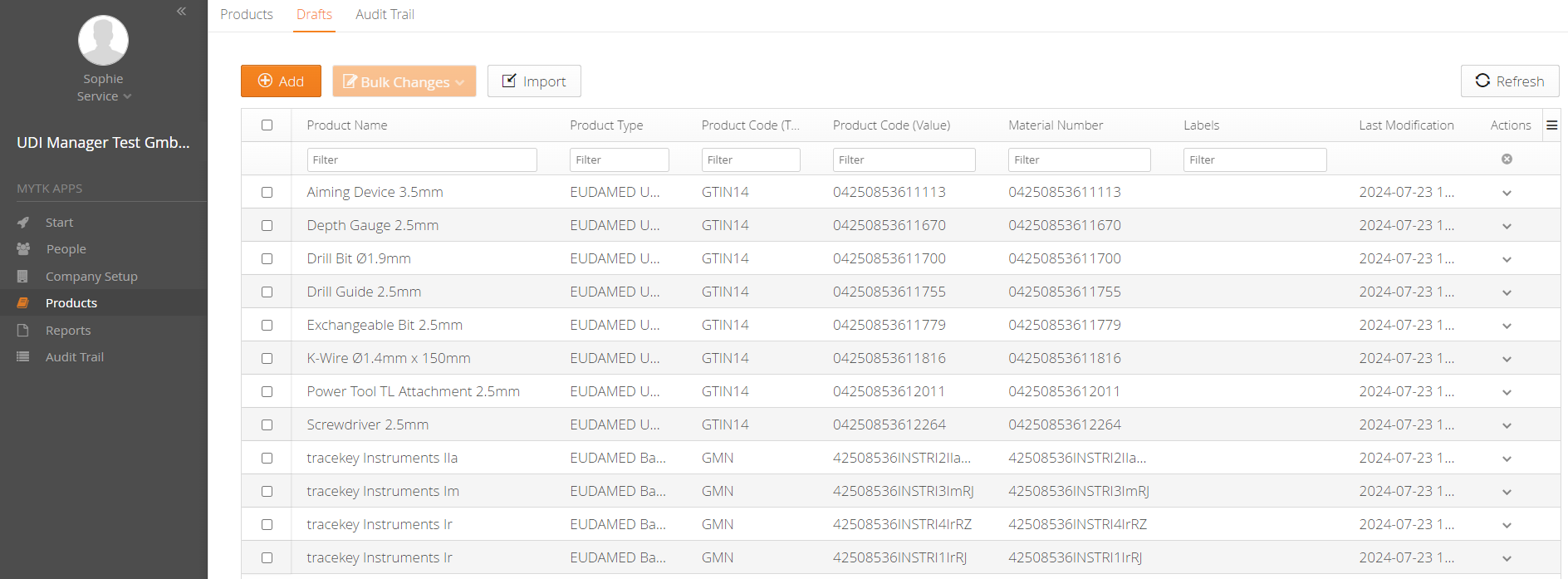
tracekey positions its eIFU tool as part of UDI management. It runs in the browser with no installation, hosts on EU infrastructure under a service level agreement, and sells its UDI Manager from EUR 99 a month billed annually, with eIFU priced on request.
Built for: teams that want UDI data, EUDAMED submissions and eIFU documents managed together.
Kallik

Best for enterprise label and artwork management
Pricing on request
Cloud platform hosted on Amazon Web Services
States ISO 27001 compliance and Cyber Essentials accreditation
Kallik's labelling platform, Veraciti, runs on Amazon Web Services, and Kallik states ISO 27001 compliance and Cyber Essentials accreditation. eIFU is one part of a wider label and artwork management system, and pricing is on request. Our Matrix eIFU vs Kallik page sets out where the two overlap.
Built for: enterprise manufacturers whose main problem is label and artwork control across many SKUs and languages.
eIFUApp

Best for RA, QA/RA and ops teams in EN, ES or FR
Pricing on request
Admin console with draft, in review, published and rejected document states
Public eIFU portal with region and language filters
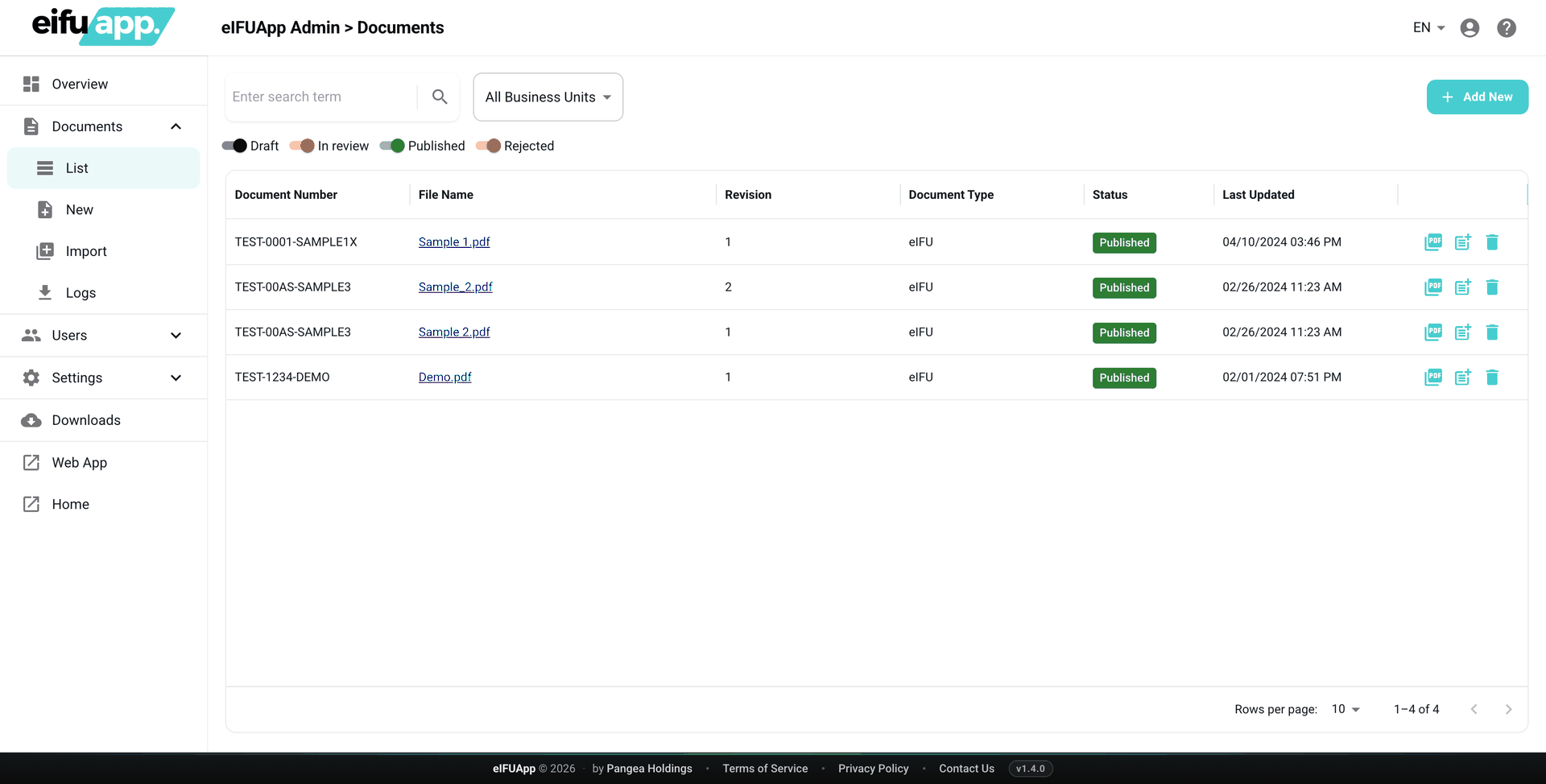
eIFUApp, at eifu.app, has an admin console with draft, in review, published and rejected document states and a public portal that users filter by region and language. It works in English, Spanish and French, and pricing is on request.
Built for: RA, QA and operations teams that want a simple document workflow in front of a public eIFU portal.
Innovatum, which drives eIFU from a labelling database, and Loftware, an enterprise labelling platform, also come up in searches. We left both off because we could not verify current eIFU detail on their own websites this month.
What is Matrix eIFU built for, and what would you buy alongside it?
Matrix eIFU is built to host, version and serve the instructions for use, answer the paper request and hand over the validation evidence. It is not an artwork management suite. If your bottleneck is label and artwork approval across thousands of SKUs, Kallik goes deeper on that job than we do, and a large manufacturer would run it alongside an eIFU host.
The two systems meet at Article 6: the label has to say the instructions are electronic and where to find them, so the artwork system and the eIFU address must agree. The same goes for document control. Your eQMS approves the IFU, and Matrix eIFU publishes the approved version. If you have no UDI data system yet, a dedicated UDI tool such as tracekey's UDI Manager covers that part of the job.
What do you need in place before Matrix eIFU works?
Three things on your side decide how fast the rollout goes:
Your master IFU list: one product line per master IFU, with the translations and regional variants that belong to it.
Your target markets and the eIFU rules in each, since Article 5(2) ties eIFU to every Member State where you sell and the US runs on section 502(f).
Your EUDAMED registration plan, because Article 7(3) ties the eIFU address to your UDI database entries.
We provide the regulatory background and templates for the Article 4 risk assessment and your eIFU QA documentation. The risk assessment itself is yours to sign. Our EUDAMED readiness page lists what to prepare for the registration step.
What do manufacturers who moved off paper tell us?
In real feedback from regulatory and quality teams, three questions come up: whether fixing an IFU or adding a translation will raise the bill, whether to build an eIFU portal in house, and what the newer IVD standard changes. We answer the first two in the FAQ below.
After go live, the feedback shifts to relief at not running a print process. A regulatory affairs manager at an orthopaedic device manufacturer in Switzerland, a Matrix eIFU customer quoted on our product page in November 2026, put it plainly: "The elimination of the paper IFU was a relief."
Summary: which eIFU software platform should you select in 2026?
Matrix eIFU is the eIFU software platform to select in 2026 for medical device and IVD manufacturers who need regulatory compliance without building and validating the system themselves. It runs the Article 7(2) website, keeps every issued version under Article 5(13), handles the Article 5(3) paper request inside 7 calendar days, links the eIFU address to UDI records in EUDAMED and GUDID, and supplies the validation documents. Its price is published: from EUR 420 a month for three master IFUs, and fixing an IFU never raises the bill.
Matrix eIFU: best overall for compliant eIFU run as one validated service with a published price.
DocuLiv: best for small EU manufacturers that want a lean eIFU portal live quickly.
RealBit eIFU: best for European quality teams that want validation documents supplied with the software.
Last updated: 13 November 2026.
Selecting an eIFU platform: frequently asked questions
It depends on what the vendor counts. Per document pricing charges for each translation and often each corrected version. Matrix eIFU counts product lines, where one product line is one master IFU with all its languages, regions and regional variants inside it, so correcting or translating an IFU never raises the bill. Ask every vendor to price the same worst case product family before you compare.
You can, but a home built eIFU site is a computer system you must validate under Article 5(5) of Regulation (EU) 2021/2226, host to the Article 7(2) standard, keep at a stable address for up to 15 years and connect to a paper request process with a 7 calendar day clock. Budget for running it for the life of the device, not for building it once.
Usually yes. The eQMS approves the document, but most have no public portal and none was built to meet Article 7(2) website duties, geo-fencing by country or the Article 5(3) paper request. Keep document control in the eQMS and publish the approved version through the eIFU platform.
Under Article 5(9) of Regulation (EU) 2021/2226, 10 years after the last device is placed on the market and at least 2 years after the expiry date of the last device produced. Under Article 5(10), 15 years for implantables and devices with no expiry date. Article 5(13), as replaced in 2025, lets obsolete versions be supplied on request instead of shown on the site.
Yes. Article 7(3), added by Regulation (EU) 2025/1234, requires you to supply the eIFU address to the UDI database under Part B, point 22, of Annex VI to the MDR, at the latest from the date UDI database registration applies to you under Article 123(3)(d) or (e) of the MDR.
No. Article 6(5) requires the eIFU to be available entirely as text, which may include symbols and graphics, with at least the same information as the paper version. Video and audio files may be added on top of the text, never in place of it.
Yes. Section 502(f) of the FD&C Act allows required labeling for prescription devices used by health care professionals to be supplied solely electronically only if the manufacturer lets users request paper and then provides it promptly and without additional cost. The statute says promptly rather than setting a number of days.