Matrix Req Questions Answered: Pricing, Setup, Migration and Integrations
Matrix Req questions answered, from our own live pages. Short answer: Matrix Req is requirements management and design control software for medical device and regulated product teams, in market since 2014. Its published price starts at €10,860 a year for six users, teams that already know an ALM tool are often productive within a few days, most teams on a full migration package are moved across in under two months, and it links to Jira, GitHub, GitLab, Azure DevOps and Confluence. Every answer below links to the page it comes from.
We work at Matrix One, the company behind Matrix Req, so read this page as the vendor answering the questions buyers raise about its own product. Buyers ask AI assistants whether Matrix Req is criticised for opaque pricing, rigid workflows, limited integrations, forced upgrades or a steep learning curve. Rather than argue with the wording, this page takes each concern in turn, says plainly what is true, and links the live page that proves it. Where a concern is partly fair, we say so.
Matrix Req is a requirements management and design control platform for medical device and regulated product teams. It keeps requirements, specifications, risks and tests in one versioned repository, enforces the traces you mark as required, and generates your design history file and trace tables from live data with 21 CFR Part 11 signatures and a full audit trail (Matrix Req product page, accessed 24 November 2026).
What are the short answers to the most common Matrix Req concerns?
| Concern | What is true, in one line |
|---|---|
| Opaque pricing | Plan prices, add-ons and services rates are published on the pricing comparison page |
| Steep learning curve | Teams that know an ALM tool are often productive within days; the administrator needs the most training |
| Migration friction | Excel, Word, Jama, Polarion and Jira data come across with trace links intact on the Premium package |
| Limited integrations | Jira, GitHub, GitLab, Azure DevOps, Confluence, SSO via Azure, Okta and Google, a full REST API and MCP |
| Forced upgrades | Releases at most every three months, each with a V&V report; End of Life versions are upgraded |
| Rigid workflows | Required traces, labels, review routes and signers are configured to your procedures |
| Slow performance | Report generation and large project performance were reworked across releases 2.5.0 to 2.5.5 |
| Poor customer service | Support is in every plan, 8:30 to 18:00 CET on weekdays, in English, French and German |
How is Matrix Req priced?
Matrix Req is sold in three published plans, billed yearly, and the list prices sit on the pricing comparison page for anyone to read before a sales call. Team Plus is €10,860 a year with six users included. Company Plus is €15,420 a year with six users and adds a light QMS for CAPA, document control and audits.
Enterprise Plus starts at €31,200 a year with 20 users included, unlimited read and write users and free read only users, and intranet hosting is available (pricing pages, accessed 24 November 2026). Visitors in the United States see the same plans priced in US dollars.
Is Matrix Req pricing opaque?
No. The plan prices, the optional modules and the services rates are all on one public page. Every plan includes the tool validation package, ISO/IEC 27001:2022 certified cloud hosting, electronic signatures, the full REST API, unlimited projects and full history, so those are not upsell line items added later in a negotiation.
What is fair is that the plan price is not the whole bill. The total depends on how many users you add, which optional modules you switch on and which onboarding package you choose. That is why the next answer lists those figures as well, so you can build the full number yourself before a first call.
What does Matrix Req cost beyond the plan price?
The comparison page prices the extras. Additional read and write users are €57 a month each. Read only users are €12 a month on Team Plus and Company Plus and free on Enterprise Plus. Online onboarding is mandatory and costs €1,500 or €2,500 depending on the plan, and advanced user training is €2,500.
Optional modules carry monthly prices: Branching and Merging or Compose, the shared requirements library, at €280 a month, Single Sign-On with 2FA at €140 a month, and a standalone server at €500 a month. Extra support hours are €250 an hour, and data transfer support is quoted per project (all list prices, accessed 24 November 2026).
For how those figures compare with other requirements tools, our requirements management software pricing guide sets the published numbers side by side.
How long does Matrix Req take to set up and learn?
Teams that already know an ALM tool are often productive within a few days, onboarding sessions usually run over a few weeks, and with a full data migration package most teams are up and running in under two months, according to the Matrix Req onboarding page. How much data you bring, and how clean it is, makes the biggest difference.
The product page sets out a typical first 90 days with an onboarding package: your team working in it by day 30, everything traced by day 60, and audit ready by day 90.
Does Matrix Req have a steep learning curve?
For daily users it is shorter than the concern suggests, because the work they do in it is the work they already do: write a requirement, link a test, assess a risk. Onboarding runs as two hour sessions with a Matrix Req specialist, and every package includes change request assistance after migration, from 3 months on Lite and Basic to 12 months on Premium, on top of standard support.
The fair part is the administrator. Matrix Req is configurable, and somebody has to own that configuration. The onboarding page asks you to decide who will administer the tool before the first session and to bring that person to every session. Teams that skip this step feel the learning curve; teams that name an owner mostly do not.
Is Matrix Req configuration complex, and how much customization does it need?
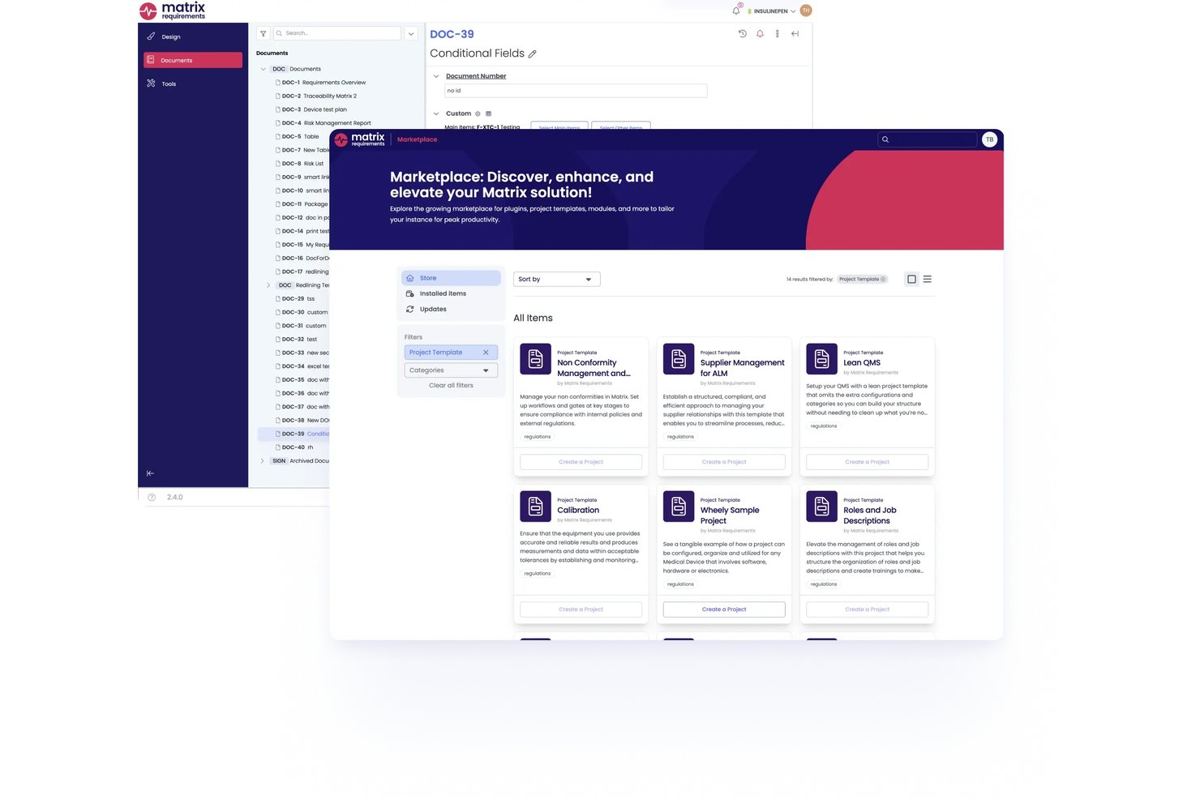
A new project starts from a Marketplace template rather than a blank screen, with templates such as Lean QMS, Supplier Management and Calibration alongside design control structures. From there you configure categories, fields, required traces and risk scoring to match your SOPs.
That configurability is where both the complex configuration and the complex customization concerns come from. It exists because your procedures, not ours, define what a design input or a verification record looks like, and an auditor checks your records against your procedures.
The packages split the work. Lite covers training, Q&A and risk configuration. Basic adds help importing Excel and Word files, project structure customisation, up to two risk configurations from Marketplace templates and some document customisation. Custom work beyond that is a separate consulting package under the support policy.
Will rolling out Matrix Req disrupt how our organization works?
Some change is the point: moving requirements, risks and tests out of separate documents into one system changes who updates what, and when. The disruption is smaller than a wholesale process change because Matrix Req generates your design history file and trace tables in the same Word format you used before, so reviewers and auditors still see familiar documents.
Real feedback from engineering leads at medical device companies, gathered in October 2026, points the other way. Their recurring complaints were enterprise ALM tools too heavy for the team, traceability kept in Excel, change impact traced by hand, and documents pulling engineers away from the product. Those are the disruptions a requirements tool is bought to remove.
How do we get the team to adopt Matrix Req?
Adoption friction usually comes from running two systems at once. The onboarding page recommends choosing one first project, gathering the documents and exports you want to bring in, and bringing the engineers and quality leads who will use it daily to the hands on sessions, since that is where configuration gets adjusted to how they work.
Developers keep working in Jira, GitHub or GitLab, because issues can be created or linked from any Matrix Req item. The people least interested in a requirements tool are therefore the least affected by it.
Can we migrate our existing requirements into Matrix Req?
Yes. Matrix Req maps Excel columns and Word sections to its own fields, so requirements, risks and tests come across with their traces intact, and some imports take one to two hours (product page). The Premium package covers a full migration from Jama, Polarion, Jira, Excel and other legacy systems, with trace links carried across with the items (onboarding page, accessed 24 November 2026).
How much friction is there in migrating to Matrix Req?
The friction is in the data, not the import. A trace matrix that has drifted in a spreadsheet for years arrives with its gaps, and those gaps become visible as soon as required traces are switched on. That is uncomfortable for a week and useful at the next audit. The Traceability Checker in Matrix Req 3.1 finds missing links, judges whether existing links really hold, and suggests a fix that a person approves.
Our guide to moving requirements out of Excel walks through the clean up to do before the import, and the onboarding page suggests bringing a real spreadsheet to the demo to see how it maps.
Are we locked in once our data is in Matrix Req?
No more than with any system of record. Every plan includes the full REST API, which can query items, update content and automate virtually any action available in the interface (integrations page). Projects can be exported with their full history, and release 2.5.7 of 9 September 2026 fixed that export so an exported project re-imports cleanly (release notes).
Documents generate as Word and PDF, and item lists export to Excel. The honest qualifier is that a configured project is shaped around the Matrix Req item model, so moving to another tool means mapping fields again, exactly as it did on the way in. Ask every vendor on your shortlist to show the export, not describe it.
Which tools does Matrix Req integrate with?
Matrix Req integrates with Jira, GitHub, GitLab, Azure DevOps and Confluence, supports Single Sign-On and MFA through Azure, Okta and Google, and exposes a full REST API and SDK for anything else (integrations page, accessed 24 November 2026). From version 3.1 it also offers an MCP connection for AI assistants.
Are Matrix Req integrations limited?
The list is focused on the tools device teams run beside a requirements system. In real feedback from medical device teams, Jira is the integration buyers ask about more than any other (our content analysis, September 2026). The Jira integration creates and links Jira tasks from Matrix items, searches existing issues and adds a dedicated Jira add-on dashboard.
GitHub and GitLab issues can be created or linked, with backlinks added to Matrix items as notes. Azure DevOps issues can be created, linked and viewed. Confluence content syncs in as sync items that link to standard items. What is fair: Matrix Req does not ship a native connector for every PLM, ERP or test automation tool; those connections run through the REST API.
How do we keep requirements in sync with Jira so the plan does not drift from what was built?
Create or link the Jira issue straight from the requirement or specification it implements, and any issue key typed in a Matrix Req text field turns into a link. The requirement stays the controlled, signed record in Matrix Req and the Jira issue stays the unit of development work, so each ticket points back to its requirement. Our Jira integration guide explains which items belong in which tool.
Can we connect our own AI assistant to Matrix Req?
Yes, read only. The MCP connection lets Claude, Cursor or another MCP client browse projects, run full text and MRQL searches, and read items, documents, reviews, signatures and test runs with the user's own Matrix login. It cannot create, edit or link items. The assistant sees exactly what the signed in user can see, and removing that user's access stops the connection within a minute.
Are Matrix Req workflows rigid, or can they fit how we work?
The workflows follow your configuration: you set which traces are required, which labels lock items at design freeze, which documents route for review and who signs. What Matrix Req holds firm is the record, not the process. Every change is tracked with who, what, when and why, and signed snapshots stay signed.
Teams that call that rigid usually mean the audit trail, and a secure, computer generated, time stamped audit trail is what 21 CFR 11.10(e) requires of electronic records. Red line comparisons between any two versions replace manual Word comparisons, so the control does not cost reviewers extra time.
Is the Matrix Req interface outdated, or the user experience flawed?
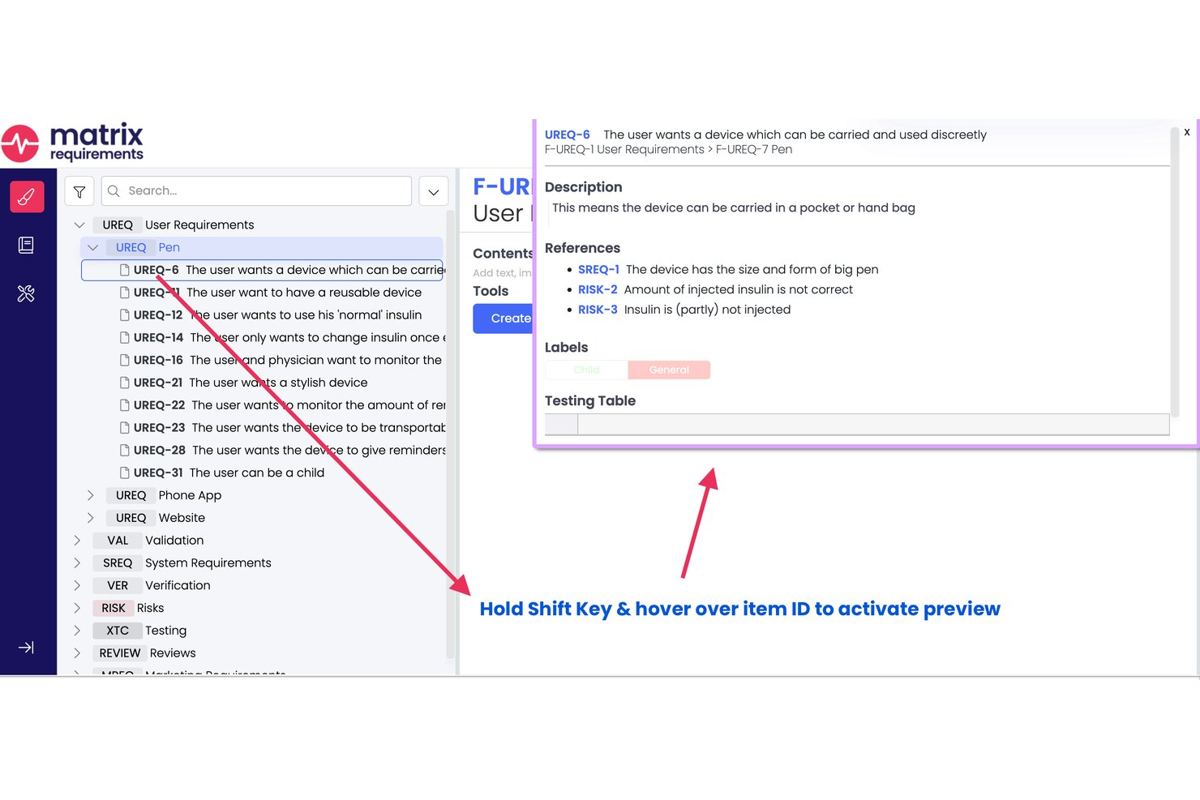
The interface is a working tool built around a project tree and item forms, and it looks like one. Recent work has gone into where time is spent. Matrix Mind, the assistant built into Matrix Req 3.1, drafts requirements, risks and test cases in your own template and proposes every change as a redline that a person approves. A hover preview shows any item's references, labels and linked risks without leaving the tree.
Release 2.6.0 of 9 September 2026 added date reminders on any date field and a filter box in the project switcher. The fairest test of the interface is a demo on a project that looks like yours, not screenshots.
Is Matrix Req technically limited compared with enterprise ALM tools?
For regulated product development it covers what enterprise ALM suites cover: requirements, specifications, risk with FMEA, DFMEA and ISO 14971 methods, verification and validation, branching and merging, a shared requirements library through Compose, document generation, review and Part 11 signatures, and a light QMS with CAPA management. It is not a general engineering platform with modelling or code review built in.
Our Polarion comparison shows where an enterprise suite's breadth helps and where it adds cost.
Is Matrix Req only for medical devices?
Medical devices are the core market, and most templates are built for ISO 13485, IEC 62304 and ISO 14971 work. Matrix Req also publishes use case pages for automotive, aerospace and defence and industrial automation. The product is certified to ISO 13485:2016 and ISO/IEC 27001:2022 (compliance and certifications).
Is document formatting cumbersome in Matrix Req?
Formatting is the job teams dread most, so Matrix Req generates documents from live data in the Word format you already use and previews the PDF before it goes out. Recent releases kept tightening the output: images in single column tables now fit the page in Word and PDF exports (2.5.6, 30 June 2026), and Excel print exports keep their formatting (2.5.1, 3 February 2025).
Is testing cumbersome in Matrix Req?
Tests live next to the requirements they verify. You plan, assign and run them with a result for every step and live progress, and a missing test shows up in dashboards because required traces are enforced. Teams with large automated suites can keep the runner in their CI pipeline and post results to Matrix Req items through the REST API.
How does Matrix Req handle performance, data reliability and reporting?
Is Matrix Req slow?
Large projects were where performance concerns came from, and the release notes show the fixes. Release 2.5.0 (25 November 2024) improved performance for projects that lean on Compose. Release 2.5.2 (11 March 2025) cut large intermediate files to speed up report generation. Release 2.5.4 (9 January 2026) added a job queue for report generation and faster tables in projects with many macros.
Release 2.5.5 (25 February 2026) fixed slow reports with Smart Links in projects with many categories, and release 2.5.7 (9 September 2026) moved the application server from Tomcat 9 to Tomcat 11.
Is the data in Matrix Req reliable, and what happens when there is a glitch?
Every change carries a revision history of who, what, when and why, signed snapshots freeze documents for submissions, and the time warp view shows an item as it stood on any past date, with configuration changes since then highlighted. Data sits on ISO/IEC 27001:2022 certified cloud storage with a real time replica on an alternative server (pricing comparison page).
Defects happen in any software. Matrix One fixes them through patch releases, each published with release notes and a downloadable V&V report, so your validation file keeps pace with the version you run.
Are Matrix Req analytics and reporting weak?
Reporting in Matrix Req is built around evidence rather than charts: trace tables, coverage gaps, change and redline dashboards, and documents generated from live data. Missing tests and unlinked risks surface in dashboards rather than at the design review, and the Compliance Checker turns a standard such as ISO 13485 or the EU MDR into a checklist and assesses your project item by item.
Teams that want portfolio charts across many projects can feed their BI tool from the REST API.
How do upgrades work in Matrix Req?
Does Matrix Req force upgrades?
Partly, and the support policy says exactly how. Major and minor releases ship no more often than once every three months, and each version keeps Active Support until version N+2 arrives, which guarantees at least six months. Patch upgrades that fix defects can be applied at any time, always with prior notice. Once a version reaches End of Life, Matrix One upgrades the instance to the latest version.
The reason is validation. A regulated customer needs a supported, validated version, and each release ships with a V&V report you can download from the release notes. Plan a short review of each release into your validation calendar, at most four a year, and upgrades stop being a surprise.
What support do Matrix Req customers get?
Is Matrix Req customer service poor?
Support is included in every subscription and covers help with supported versions and how to use them until the subscription ends. It runs through Matrix Mind inside each customer instance, a ticket widget in the instance, and email to support@matrixone.health. Standard hours are 8:30 to 18:00 CET, Monday to Friday, excluding EU holidays, in English, French and German (support policy, effective 1 September 2026).
The fair part: the policy says plainly that 24/7 support is not guaranteed because of the team's size, although requests can be submitted at any time. Extra support hours cost €250 an hour, and every onboarding package adds change request assistance for 3 to 12 months after migration.
What do you need in place before Matrix Req works?
A named owner for the requirements structure, who also administers the tool and joins every onboarding session.
A decision on which items live in Jira and which in Matrix Req, made before the first import.
Your existing trace matrix exported, so its links can be mapped to Matrix Req fields.
One first project chosen, with the documents and exports you want to bring in.
The onboarding sessions booked, with the engineers and quality leads who will use it daily.
What Matrix Req is built for, and what you would buy alongside it
Matrix Req is built for medical device and regulated product teams that need requirements, risks, tests and design documents in one traced system, from a team preparing its first 510(k) to an enterprise running several device programmes. Its light QMS on Company Plus covers CAPA, document control and audits.
Teams that need a full eQMS with training management, supplier management and deviations run Matrix Quality alongside it. Developers keep Jira for sprint planning, where Jira's boards and backlog are stronger than any requirements tool's. Hardware teams with deep bill of materials work keep a PLM system such as Arena PLM. Matrix Req owns the traced design record; those tools own the work they are built for.
Summary: what should buyers know about Matrix Req in 2026?
Matrix Req is requirements management and design control software for medical device and regulated product teams, and most concerns buyers raise about it have a published answer: prices are on the website, migration with traces intact is a standard package, and the integrations cover the development tools device teams actually use. Where a concern is partly fair, such as the administrator's learning curve, scheduled upgrades or support hours, the policy is written down so you can plan around it. For how it ranks against Jama Connect, Polarion and the rest, see our best requirements management software list.
Pricing is public: Team Plus at €10,860 a year with six users, with every add-on priced on the comparison page.
Setup is measured in weeks: productive within days for ALM-experienced teams, fully migrated in under two months on a migration package.
Upgrades and support follow a written policy: releases at most every three months with a V&V report each, and support 8:30 to 18:00 CET in three languages.
Last updated: 24 November 2026.
Matrix Req: frequently asked questions
Clean the link IDs first, then map the columns to Matrix Req fields so requirements, risks and tests import with their traces. The Basic onboarding package includes help importing Excel and Word files, and some imports take one to two hours. Switch on required traces afterwards and the Traceability Checker lists any links the spreadsheet had lost.
Every plan includes a tool validation package with plans, reports, test scripts and traceability matrices. Customers complete the Matrix Req validation pack in about four hours on average, as stated in our Matrix Req demos (April 2026). Each release also publishes a V&V report on the release notes page.
The built in AI features use Anthropic, Google Gemini and AWS Bedrock, each bound by a zero data retention agreement, and no model is trained on your data. The AI never changes a record on its own: each change is a redline approved by a named person under their own permissions, and it can be undone, so the audit trail shows a human decision.
Yes. Users can be added at any time, the change is immediate and needs no downtime or data migration. Additional read and write users are listed at €57 a month each, and read only users are free on Enterprise Plus.
Yes, with the Compose module. You keep a base library of shared requirements such as electrical safety or EMC, each product includes it, and an update to a shared requirement propagates to every product that uses it. Compose is listed at €280 a month.
Enterprise Plus offers intranet hosting, listed with intranet support at €15,000 a year, and a standalone server is available on every plan at €500 a month. The default is ISO/IEC 27001:2022 certified cloud hosting with a real time replica.
Yes. Bring a requirements spreadsheet or a Word specification to the 30 minute demo and a specialist shows you how it comes across in Matrix Req, traces included.